Servicios
|
At a meeting today, the Board of Directors approved Banco de la República’s financial statements for 2006. Pursuant to Law 31/1992, it will transfer Col$1.18 trillion pesos in profits to the national government. These funds will be turned over in US dollars.
|
|
At a meeting today, the Board of Directors approved the Banco la República’s financial statements for 2007. Pursuant to Law 31/1992, the Bank will transfer Col$1.4 trillion pesos in profits to the national government.Most of the profits came from the return on international reserves.…
|
|
At its meeting on 30 August 2019, the Board of Directors of Banco de la República (the Central Bank of Colombia) adopted a new communication scheme for monetary policy decisions. The purpose of these changes is to facilitate the understanding of the decisions by the markets and the general public.…
|
|
For this decision, the Board mainly took into account the following information:
|
|
The Board of Directors mainly took into consideration the following information:
|
|
President Iván Duque Márquez announced last Friday, 27 December, on Twitter, the appointment of economist Arturo José Galindo Andrade, Universidad de Los Andes alumnus, as the new member of the Board of Directors of Banco de la República, replacing José Antonio Ocampo.
|
|
ISO 14001 version 2015 corresponds to the international certification standard granted to organizations for their responsibility and commitment to environmental protection, appropriate management of environmental risks and impacts, and sustainable use of resources.
|
|
Press, print version
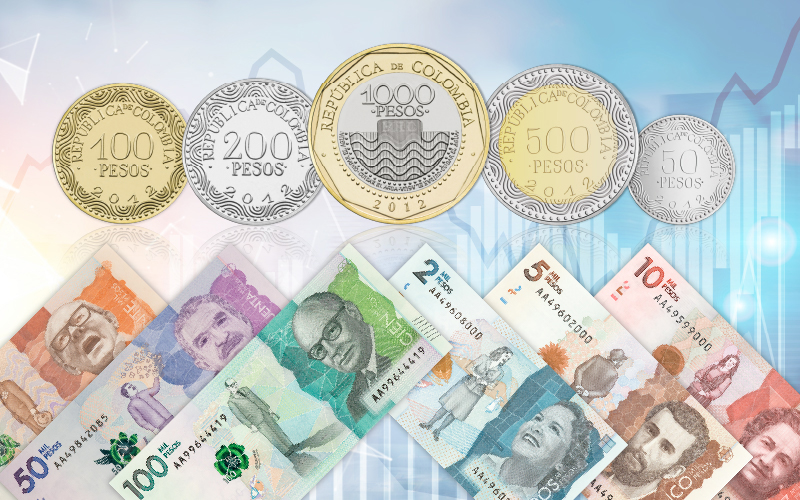
In 2016, Banco de la República will release a new family of banknotes composed of six denominations: $2,000, $5,000, $10,000, $20,000,
|
|
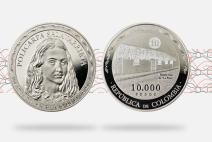
This image does not match the final design of the commemorative coin of the bicentenary of Colombian independence. It is an approximation, and the final artwork may undergo variations in the coming days. In order to use or reproduce this image, you must consider that it is not the final design.…
|
|
In their session today, the Board of Directors of the Banco de la Republica decided to keep the benchmark interest rate unaltered at 4.5%. The decision was made with the following in mind:
|
|
At a meeting on April 30, the Board of Directors agreed to manage the bank reference indicator (BRI), as requested by the Colombian Banking Association (Asobancaria). The design of this indicator reflects the reference interest rate representative of liquidity conditions on the money market.The BRI…
|
|
As delegated by the Board of Directors of Banco de la República, the Monetary and Exchange Intervention Committee decided today, in its ordinary session, that Banco de la República will rollover its U.S. dollar non-delivery forward contracts in December 2020, through auctions held…
|
|
As delegated by the Board of Directors of Banco de la República, the Monetary and Exchange Intervention Committee decided today, in its ordinary session, that the Central Bank will rollover its U.S. dollar non-delivery forward contracts in February 2021, through auctions held on the maturity dates.
|
|
On 3 November 1998, Banco de la República (the Central Bank of Colombia) launched the Electronic Trading System (SEN). The SEN is a technology infrastructure managed by the Central Bank for the negotiation and registration of transactions with public debt bonds holdings at the Central Security…
|
|
On May 9 and 10, Banco de la República (the Central Bank of Colombia) through the Economics Researchers Network, the National Bureau of Economic Research (NBER), and the Andean Reserve Fund (FAR) will hold the conference “Emerging and Frontier Markets: Capital Flows, Resiliency, Risks, and…
|
|
In their meeting today, the Board of Directors of Banco de la Republica, the Central Bank of Colombia, defined the 2012 inflation target in 3%+/-1pp. The Board believes that the conditions or the Colombian economy let foresee that, hereinafter, inflation will remain in this range corresponding to…
|
|
The Board of Directors of Banco de la Republica, the Central Bank of Colombia, has decided to increase de intervention interest rate by 25 base points. Therefore, the base rate for expansion auctions will be 5.00%. In the decision-making process, the following was taken into account:…
|
|
The Board of Directors of Banco de la Republica, the Central Bank of Colombia, decided today to maintain its intervention interest rate unaltered at 4.75%. This decision was made in taking the following into account:
International financial markets continue to show high volatility levels as…
|
|
The Board of Directors of Banco de la Republica, in their meeting held today, decided to keep unaltered the intervention interest rate at 4.5%. This decision was made after due consideration of the following:
|
|
The Board of Directors of Banco de la Republica, in their meeting held today, decided to keep unchanged the intervention interest rate at 4.5%. This decision was made after due consideration of the following:
|
|
According to the thirteenth version of the Opinion Panel of the Cifras & Conceptos firm, Banco de la República was once again recognized as the institution that generates the most trust among opinion leaders. This year it received a rating of 69 points out of 100, which is a higher score than…
|
|
With a score of 68 points out of 100, Banco de la República was recognized as the institution that generates the most confidence among the country's opinion leaders. This is according to the twelfth version of an opinion poll conducted by Cifras & Conceptos.The firm surveyed 2,004 opinion…
|
|
Six Board Members voted in favor of this decision and one member voted for a 50-bp increase.
In its policy discussion, the Board considered the following elements:
|
|
The decision was based on the following considerations:
|
|
During the previous month, adverse financial conditions worsened, brought on by global and idiosyncratic factors. These conditions caused —among other effects— a higher monthly depreciation than that of other emerging economies.
|