Book Memorias del Banco de la República en su primer centenario (Memoirs of Banco de la República on its first centennial anniversary)
Los libros y capitulos de libros que se publiquen o editen, pertenecen a sus respectivos autores y, por ende, no comprometen necesariamente a la Entidad, a menos que así se indique en forma expresa. Para más información consulte nuestro Aviso Legal.
The book Memorias del Banco de la República en su primer centenario published in 2023 can be downloaded from Banco de la República Repository, as well as from Virtual Library.
Editors’ note
A central bank fulfills three essential functions: it issues the circulating currency, it is the bank of banks, and it acts as the Government's fiscal agent. In fulfilling these functions, it regulates the payments system, manages foreign reserves, is an essential participant in the public debt market, and--more generally--designs and executes the monetary policy. Central banking activities are a natural monopoly that is efficiently exercised by a single institution in each economy.
In Colombia, in 1923, the civil society delegated central banking responsibilities to Banco de la República, which since then has fulfilled the essential functions listed above. Besides these core activities, over time, legislation and public policy decisions have changed the spectrum of additional activities performed by the Bank. For example, to fulfill the administration of Government revenues, it was engaged for several years in the development of the country's salt mines and was also in charge of the purchase of all the gold produced in the country.
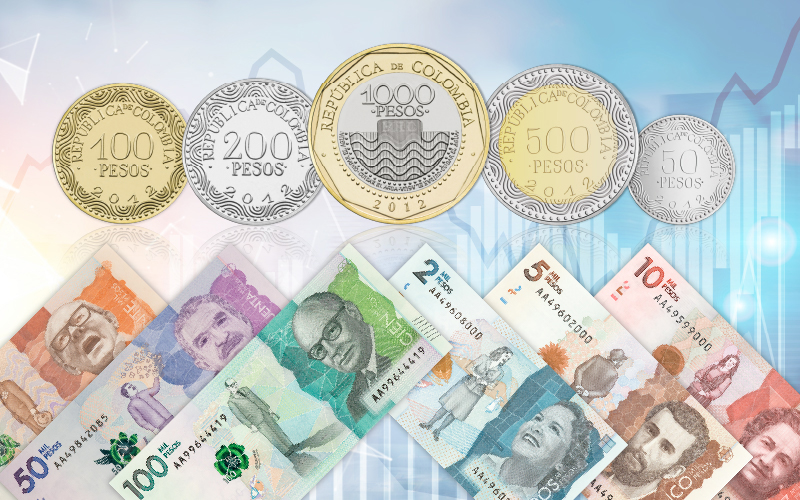
It is difficult to overstate its success in its primary role as an issuer of circulating currency. Since its foundation, the Bank has issued the Colombian peso without ever changing its denomination. Despite the country's geographical and political difficulties, its citizens have used and continue to use its currency in all their transactions and as a deposit of the value of their savings. Even in remote and border territories, the peso is the predominant currency with a value that no one doubts. Moreover, in the Latin American context, its stability is extraordinary, and it is a treasure of society.
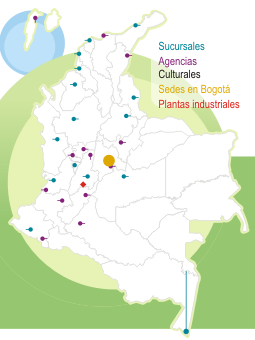
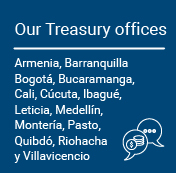
In a country with multiple and remote regions such as Colombia, fulfilment of the Bank's functions has benefited from a strong institutional presence throughout the national territory. This presence is provided through an important network of offices in several large and medium-sized cities. For decades, the network of offices was instrumental in executing development loans and gold purchase activities. After the 1991 Constitution, the Bank ceased to provide credit to the tertiary sector; it also ceased to be the only authorized buyer in the gold market. Since then, the network of offices has concentrated on the distribution of monetary species and on cultural activities, which are a peculiar function of the Bank. The Issuer's cultural activity has its roots in the creation of the Gold Museum and the Luis Ángel Arango Library. This work, assigned by law, extends to the conservation of different types of heritage assets, from archeological remains and works of art to photographic and business archives. The Bank has also been responsible for the careful recording of its history through publications and the diligent preservation of its documentary archives.
There is an extensive collection of documents and books describing multiple technical and legal aspects of the history of Banco de la República. Most of this literature has come from the Bank itself, its staff, and researchers, and has focused on describing and analyzing the causes and consequences of policies developed by the Bank. This book aims to partially fill a gap that exists in the literature on the development of the technical support necessary to carry out the institution's missional endeavors for a century.
The first three chapters describe the Bank's core central banking operations since its founding. The first chapter covers the production and issuance of circulating currency, which involves substantial industrial activity. The second chapter describes the Bank's participation in the development of interbank payment systems beyond cash. The third chapter deals with the economic analysis and research activity that has supported monetary policy decision-making processes. This is followed by two chapters on the history of the Bank's branches and the development of information technology, pillars of its operations on all fronts. The sixth chapter is devoted to the history of gold purchasing, which was an essential part of all the Bank's operations until its functions were redefined after the 1991 Constitution. Precisely, the Gold Museum and all associated archaeological preservation work are a legacy of this function, which is well-known by the Colombian society. Chapter seven tells the story of the administration of the decades-long salt mines, a work that is perhaps less known today [...].