Report on Financial Market Infrastructures and Payment Instruments 2026
In 2025, Banco de la República (the Central Bank of Colombia) continued to oversee FMIs and the use of payment instruments in Colombia, as well as international trends and innovations in payments. This edition places particular emphasis on interoperability, both in financial market infrastructures and in payments.

Publication Date:
Financial Market Infrastructures in Colombia
Payment Infrastructure in Financial Markets
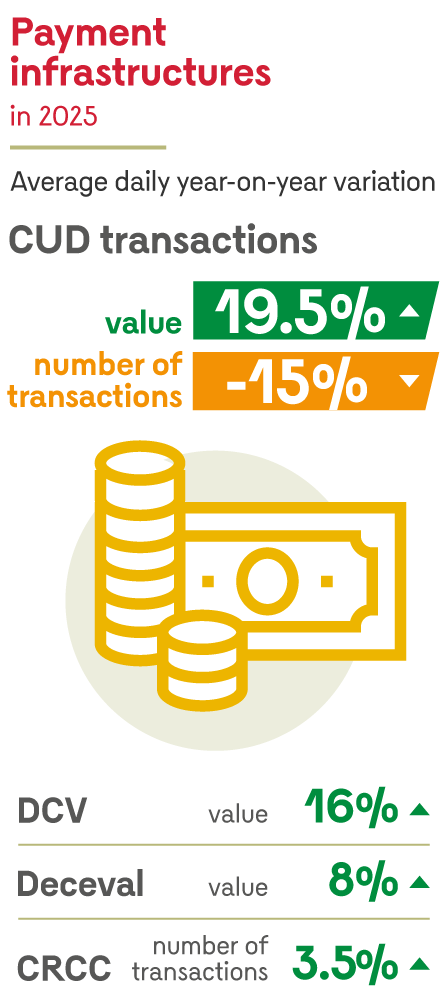
- In 2025, Banrep’s large-value payment system, the Deposit Accounts System (CUD, for its acronym in Spanish), exhibited greater activity. The average daily value of settled transactions increased by 19.5% compared with the previous year, despite a 15% decline in the number of transactions. This outcome reflected changes in money market liquidity conditions, associated with higher volumes of sell/buy-back transactions through Banrep’s liquidity-absorption facility.
- In line with developments in the CUD, securities depositories also showed higher activity. At Banrep’s Central Securities Depository (DCV, for its acronym in Spanish), the average daily value of settled transactions increased by 16%, driven by higher activity in open market operations, liquidity-providing operations for the large-value payment system, and sell/buy-back transactions.
- At the Centralized Securities Depository of Colombia (Deceval), the average daily value of cleared and settled transactions increased by 8.0%, reflecting stronger activity in the equity market.
- At the Central Counterparty Clearing House of Colombia (CRCC, for its acronym in Spanish), the number of cleared transactions increased by 3.5%, driven by growth in the fixed-income and equity segments.
Retail Payment Systems
- In 2025, Colombia’s Automated Clearing Houses, ACH Colombia and ACH Cenit, recorded annual increases of 15% in value and 2.3% in the number of transactions processed.
- During 2025, retail payment systems that clear and settle debit and credit card payment transactions recorded 21% increases in transaction value and 19% in transaction volume.
- The implementation of the Operational Settlement Mechanism (MOL, for its acronym in Spanish), as part of the Bre-B framework, introduced a new dimension to the oversight of instant retail payment systems and the assessment of intraday liquidity. Since October 2025, Bre-B instant transfers have been settled through the MOL on a 24/7, gross, real-time basis against deposit accounts held at Banrep. During its first months of operation, available funds remained stable while the value of transactions processed increased gradually, highlighting the importance of monitoring liquidity dynamics under this new operating framework.
- The instant payments ecosystem showed greater interoperability among institutions and payment systems. Although most transactions continue to be processed within each instant retail payment system, records from the MOL show an increase in transaction flows between instant retail payment systems.

Payment Instruments
- In 2025, the use of retail electronic payments in Colombia continued to expand. Transfers remained the most widely used electronic payment instrument, driven by the growth of intrabank transfers, mobile wallets, and instant transfers made through Bre-B.
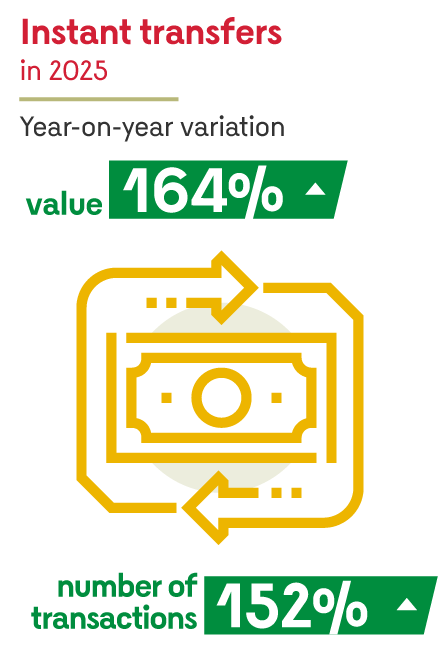
- Instant transfers recorded significant growth, reaching a transaction volume equivalent to 2.5 times the number of traditional interbank transfers.
- Debit and credit card purchases continued to increase.
- Checks continued to lose share in terms of the number of transactions, although they remain relevant for large-value payments, particularly those made by legal entities.
- Cash remains the payment instrument most commonly used for everyday transactions. However, its use continues to decline, in contrast to the increase observed in currency in circulation.
Trends and Innovations in Payments
- The tokenization of central bank reserves could help modernize transaction settlement while preserving their role as a safe settlement asset. However, its benefits depend on integration with existing financial market infrastructures and on preserving settlement in central bank money, as well as security, and financial stability.
- Regional interoperability among post-trade infrastructures could support the integration of stock exchanges, provided that it is implemented gradually and under an appropriate risk-management framework.
- The interconnection of instant payment systems could enhance cross-border payments by making them faster, more traceable, and more efficient. International experience shows that achieving these benefits requires common standards, clear rules, and adequate risk management.
Boxes
Box 1: Interoperability in Colombia's Instant Payments Ecosystem (only in Spanish)
Box 2: Regional Interoperability of Post-Trade Infrastructures (only in Spanish)
In Focus
In Focus 1: Payments made through Postal Payment Operators (only in Spanish)
In Focus 2: Bre-B: Interoperable Instant Payments System (only in Spanish)