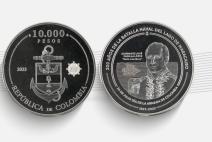
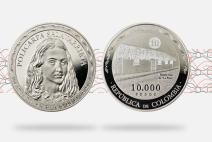
Book Historia de la moneda en Colombia (History of Currency in Colombia)
Los libros y capitulos de libros que se publiquen o editen, pertenecen a sus respectivos autores y, por ende, no comprometen necesariamente a la Entidad, a menos que así se indique en forma expresa. Para más información consulte nuestro Aviso Legal.
The book Historia de la moneda en Colombia published in 2023 can be downloaded from Banco de la República Repository, as well as from Virtual Library.
Introduction
The study of currency, which includes its origin, characters, and functions, as well as the phenomena it causes (a subject recognized as the vastest and complex in political economy), forces us to go back to primitive times to establish the beginning of the slow evolution of all the facts related to wealth. Therefore, it is necessary to consider that remote era called the pre-economic age, in which production appeared among the first wanderings of mankind.
Man, then struggling in almost absolute isolation, was driven to the conquest of wealth by the tyrannical needs of his animal structure. With no elements to help him in his labors, these were reduced to extracting, through rudimentary procedures, the fruits appropriate to satisfy the most imperious of those needs. He felt hungry and had to occupy himself with hunting and fishing; he suffered the rigors of cold and had to cover himself with the skins of animals; he was overcome by sleep and fatigue, and harassed by the inclemency of nature and found in the leaves and in the tough bark of the trees a roof to cover his dwelling. He used stone by carving it with the same stone, and the forest provided him with his own material to manufacture his first tools. Thus he created the first capital and constituted the first industry with his daily work.
The economy of those times gave rise only to production and consumption, since wealth, once produced, was immediately consumed. Thus, these two phenomena appeared, which have been and will always be the extremes of the complex chain of social economy, and which will disappear from the world only when people themselves have also disappeared.
Human beings were born with different intellectual, moral, and physical capacities, and thus, provided with elements of unequal power, they were placed upon earth. As men were forced to produce, there had necessarily to be inequality of results and diversity of products.
As the growth of families brought with it an increase in needs, life--previously simple and rustic-- became more demanding, and it was necessary that the primitive work of all its members remained only as the labor of some, and that the others were occupied, within the order of their capacities, with the production of many other objects. This caused the division of labor, an inflexible law, and the basis of our current economic organization.
Once wealth was obtained in amounts higher than the individual and domestic needs of the producer, man found himself with a surplus of products, while at the same time he lacked other things that he could not produce. Men were then instinctively led to exchange, that is, to give the surplus of the products of their industry for the surplus of that of others, so that, in this way, everyone could acquire what they needed. Consequently, the exchange introduced the circulation of wealth, and with it also appeared distribution. Certainly, each one remained the owner of what he had received through exchange. Exchange also emerged as a regulating element of social forces, as the keeper of the balance of nascent society, and as the just distributor of wealth, since it placed men on an equal footing to satisfy their needs.
This is, broadly speaking, the picture of primitive economy. Society, governed in the field of wealth by these four great phenomena (production, circulation, distribution, and consumption), slowly developed and improved until the genius of man brought it to the height of civilization we see today. Immense factories, equipped with gigantic machinery, carry out the trade that in remote times was done by the calloused hand and the carved stone. From the uncomfortable barter of products, we have reached the scientific monetary systems and the wonders of credit, and savings and capitalization have replaced the abrupt disappearance of wealth in the field of consumption.
Let us go back to the incipient circulation to set the time when money […]