Box 2: Inflation Expectations and Their Recent Evolution Inflation - Report of the Board of Directors to the Congress of Colombia, March 2026
Pursuant to Article 5 of Law 31 of 1992, the Board of Directors of Banco de la República (the Central Bank of Colombia) submits a report to the Honorable Congress of Colombia, informing about the performance of the economy and its outlook. This report is submitted twice a year, in March and July, within ten business days following the start date of the sessions of the Congress.
Inflation expectations refer to the level of inflation that economic agents anticipate in the future. In other words, they are the estimates made by individuals or groups regarding expected increases in the prices of goods and services most frequently consumed by households. These expectations are primarily measured through surveys of various market participants (such as analysts, firms, trade unions, among others), as well as through indicators derived from domestic sovereign debt securities, calculated as the yield differential between inflation-indexed bonds and nominal bonds (break-even inflation).
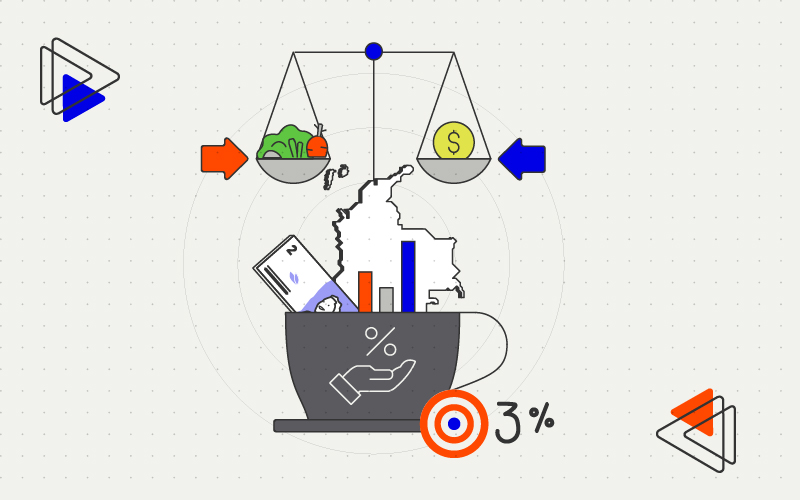
In conducting monetary policy, inflation expectations play a central role, particularly under an inflation-targeting framework. In addition to being a key input for the decision-making process of the Board of Directors of Banco de la República (BDBR), inflation expectations directly influence economic agents’ decisions regarding consumption, savings, investment, and price-setting. Likewise, they play a key role in the transmission of monetary policy: when agents trust that the authority will take sufficient measures to achieve the 3.0% target, they adjust their decisions accordingly, thereby facilitating and accelerating price stabilization. If expectations remain anchored to the target, the credibility of the monetary authority is strengthened, the effectiveness of its actions is enhanced, and the costs of economic activity are reduced.
Since inflation expectations are an unobservable variable, Banco de la República uses different sources and methodologies to estimate them:
- Surveys that directly capture the views of economic agents: the Monthly Survey of Economic Analyst Expectations (EME in Spanish), and the Quarterly Survey of Economic Expectations (ETE), which gathers perceptions from a sample of institutions in the following economic sectors: manufacturing industry and mining, the financial system, large retail chains, transport and communications, academics and consultants, and trade unions, across the four main cities of the country: Bogotá, Medellín, Cali, and Barranquilla.
- Implicit inflation measures are derived from the public debt market and are known as break-even inflation (BEI) and forward break-even inflation (FBEI). In Colombia, these are calculated by comparing the interest rates of Colombian sovereign bonds (TES) issued in nominal terms with TES indexed to inflation (Real Value Unit, UVR).
Surveys have the advantage of directly capturing agents’ perceptions and enabling the identification of differences across participant types and time horizons. However, they tend to focus on shorter horizons, are conducted less frequently, and may be subject to response biases or representativeness issues. On the other hand, measures derived from the public debt market provide daily information, enable analysis across a wide range of horizons, and reflect expectations embedded in market decisions...
 Reports
 Boxes
Boxes  Press Releases
 Presentations (only in Spanish)