

The Constitution and constitutional jurisprudence assign Banco de la República the specific mission of preserving the currency’s purchasing power. This translates into the objective of achieving and maintaining a low, stable inflation rate, in tandem with general economic policy, while taking into account economic growth.
Publication date
Banco de la República is working to bring inflation back to the 3% target while ensuring that the impact of this convergence on economic growth remains as negligible as possible. Keeping inflation low and stable is a fundamental precondition for the economy to grow sustainably over time.
In modern states, central banks are part of the public policy infrastructure that seeks to maximize societal well-being. The specific role of central banks is to control the general level of prices in order to uphold the currency’s purchasing power. Consequently, central banks focus on maintaining a low and stable inflation rate and conduct ongoing evaluations of all the factors that affect it. When inflation is predictable, low, and stable, companies and households can make more efficient investment and consumption decisions, allowing them to achieve the maximum level of economic activity that the economy can sustain with its available resources.
A common policy tool used by central banks is the policy rate, the interest rate they use as a benchmark for lending or borrowing from commercial banks on very short terms. In turn, this interest rate is transmitted to other interest rates in the economy through the loans that commercial banks extend and the deposits they receive from other agents in the economy.
In general, inflation reflects the gap between the economy’s requirement for goods and services, commonly termed ‘demand’, and its capacity to produce and provide them, commonly known as ‘supply’. When demand exceeds supply, prices rise faster, and inflation rises. Under this scenario, if inflation deviates from the target, the central bank will raise the benchmark interest rate, which in turn makes borrowing more expensive and saving more profitable than spending. This consequently discourages consumption and investment, thus adjusting the total demand for goods and services in proportion to the economy’s supply. Similarly, when demand grows more slowly than supply, prices grow more slowly, and inflation falls. If, as a result, inflation falls below the central bank’s target, the central bank will lower the benchmark interest rate to stimulate consumption and investment, thereby bringing aggregate demand closer to aggregate supply.
Nevertheless, certain situations might arise that do not align with this natural behavior. A challenging situation for monetary policy can arise when inflation rises due to temporary cost increases or transitory supply disruptions, such as those caused by extreme weather events (e.g., droughts or floods). In these cases, the increase in inflation is not accompanied by growth in demand that exceeds the long-term growth in supply. If the rise in inflation is fully reversed by the end of the supply disruption, the central bank will not need to raise interest rates. However, the increase in inflation may persist due to its effect on the inflation expectations of businesses and workers, or due to the widespread presence of price and wage indexation mechanisms. These impacts are known as “second-round effects” and may require an adjustment of the central bank’s interest rate to bring inflation back to target, with a consequent reduction in consumption and investment growth. Nonetheless, this negative effect on economic activity is transitory and disappears when inflation firmly converges toward the inflation target.
In Colombia, the constitution and constitutional jurisprudence assign Banco de la República the specific task of controlling inflation in alignment with general economic policy, taking economic growth into account. For this reason, the Bank sets an annual inflation rate target of 3% and, in making decisions to achieve this target, considers its impact on economic activity within the framework of the inflation-targeting strategy discussed in a previous blog.
Graph 1 shows the growth and inflation environment that the Board of Directors of Banco de la República has faced when setting its policy interest rates over the past decade. In particular, the graph illustrates the annual growth and inflation rates between 2015 and 2025, as well as the average intervention rate for each year. The dotted segments of the lines denote the growth and inflation forecasts of the Bank’s technical staff for December 2026, as reported in the most recent Monetary Policy Report, 2.5% and 6.9%, respectively. For reference, the annual inflation target is also shown: 3%.
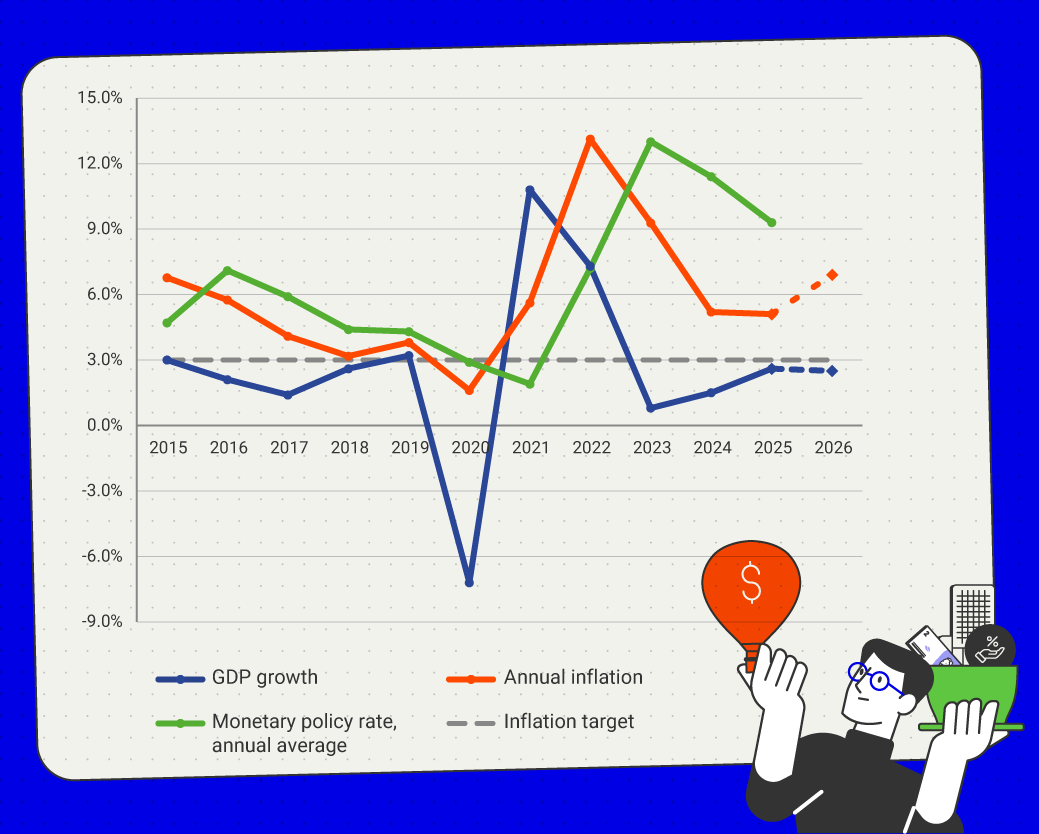
As can be seen, in the pre-pandemic years, 2018 and 2019, the annual inflation rate was below 4% (3.2% and 3.8%, respectively), while economic growth was robust (2.6% and 3.2%, respectively). As a result, the intervention interest rate was relatively low, averaging 4.3% over those two years. During the 2020 pandemic, economic activity collapsed, and inflation fell due to reduced demand for goods and services across the economy. Consequently, the Board of Directors of Banco de la República reduced the benchmark interest rate to a very low level of 1.75%, where it remained until almost the end of 2021.
With the gradual return to normality after the pandemic in 2021 and 2022, the economy recovered rapidly, while inflation rose substantially, driven by supply shocks stemming from external and climatic factors. To contain inflation, Banco de la República began a cycle of gradual increases in the policy interest rate, and, as a result, inflation and growth jumped on a clear path of adjustment. In 2024, once inflation began to decline, the Bank began a cycle of reducing its intervention rate that lasted until 2025.
As the graph shows, the fall in inflation stalled in 2025 as economic activity accelerated once again. For 2026 - with the information available - the Bank’s technical staff forecasts that inflation will rise to 6.9% as a result of the shock from increased wage costs and the growth of domestic demand exceeding supply. In turn, the annual growth forecast is 2.5%, close to that observed in 2025. In this environment of strong positive growth, the Bank raised its policy interest rate from 9.25% in December 2025 to 12% in July 2026, seeking to contain demand and place inflation on a downward path toward its target.
In the near future, the Bank’s Board of Directors will continue to make its policy interest rate decisions based on available information, seeking to bring inflation toward its target. Decisions are adjusted to minimize their negative effects on economic activity and ensure that the economy reaches its maximum sustainable growth.