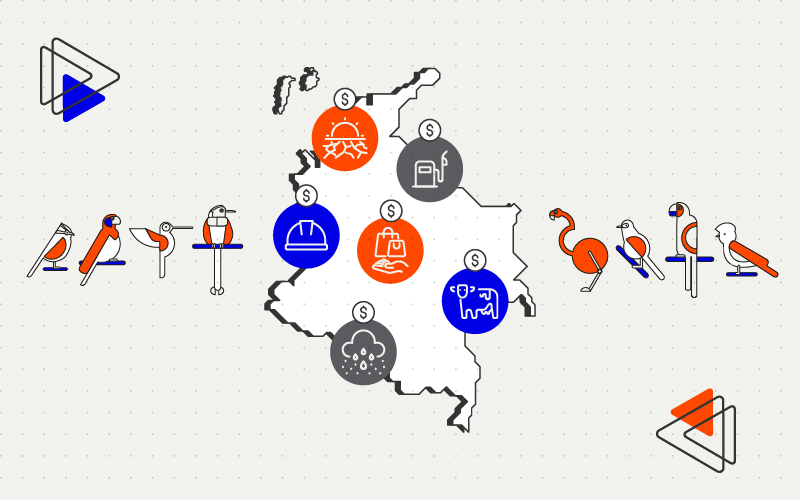
When we hear that the economy has grown, we may assume every household, business, and region in the country experienced the same narrative. However, that’s often not the case. A good harvest can boost one region’s performance, while construction challenges may slow down another’s. To really…
Zamudio-Gómez, Nancy Eugenia
Below are the contents available on the site related to the query.
- Entrada de Blog |
- Entrada de Blog |
The Colombian Constitution and law establish that Banco de la República’s (the Central Bank of Colombia) primary mission is to preserve the purchasing power of the national currency, consistent with overall economic policy. The purchasing power of the Colombian peso depends on the prices of…
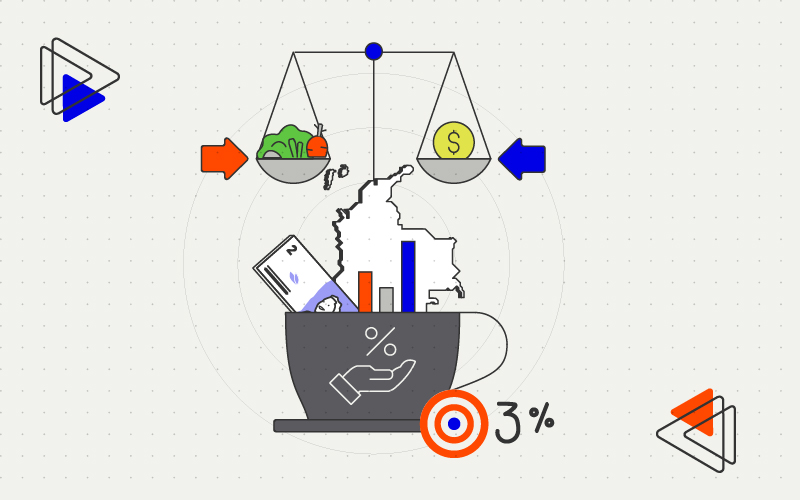
- Entrada de Blog |Banco de la República is working to bring inflation back to the 3% target while ensuring that the impact of this convergence on economic growth remains as negligible as possible.
- Entrada de Blog |
After a prolonged period of price stability, global inflation rose in 2021 and 2022 to unexpectedly high levels, reaching an average of 8.7% in 2022. In advanced economies, average annual consumer inflation increased from 0.7% in 2020 to 7.3% in 2022, while in emerging and developing economies…
- Entrada de Blog |
In recent discussions about Colombia’s macroeconomic environment, the weakening relationship between Banco de la República’s (the Central Bank of Colombia) monetary policy rate (MPR, or the benchmark policy rate) and market interest rates has received comparatively little attention. Indeed, in…
- Entrada de Blog |
A common feature of modern central banks is their independence from the government. This autonomy is justified because the goals of the government and the central bank can differ. Typically, governments prioritize short-term growth and therefore favor low interest rates to boost demand and ease…
- Entrada de Blog |
According to the prevailing view in Latin America of the mid-20th century—which saw active state intervention as essential for promoting development—central banks were assigned a significant role as development banks. On this basis, they were expected to direct part of domestic savings under…
- Entrada de Blog |
Each year, Banco de la República (the Central bank of Colombia) generates profits that, by law, must be transferred to the Government once the equity reserves in this same law have been deducted. In March of this year, Banco de la República will transfer to the National Government approximately…
- Entrada de Blog |
Recent installments of this Blog introduced crucial elements of monetary policy, such as the inflation target and the…
- Entrada de Blog |
Inflation is the generalized and sustained increase in the prices of goods and services. When inflation is high, money loses its value rapidly, which affects all sectors of the economy, especially households, as their purchasing power declines. This means that with the same amount of money, a…
- Entrada de Blog |
Since early 2024, interest rates on long-term Colombian government debt bonds, hereafter referred to as government bonds, have been increasing. This means that the government must pay more interest on its debt, so a larger share of its revenues must be allocated to cover such interest payments…
- Entrada de Blog |
Banco de la República’s policy interest rate is currently 9.25%. The policy interest rate serves as the benchmark that the Bank uses to lend to or borrow from commercial banks over very short terms. As with other central banks worldwide, it is the main policy instrument used to achieve the…
- Publicación |
Abstract
- Publicación |
Abstract
- Publicación |
This study presents an alternative way of estimating credit transition matrices using a hazard function model. The model is useful both for testing the validity of the Markovian assumption, frequently made in credit rating applications, and also for estimating transition matrices conditioning on…
- Publicación |
The private corporate sector is the primary debtor in the Colombian financial system (commercial loans account for 54.9% of the total gross portfolio). Consequently, it is extremely important to measure and monitor the risk this sector of the economy might pose to the financial system. Ever…
- Publicación |
Bankruptcy is a threat to financial stability, if a company fails to meet its financial obligations. Obviously, the risk to financial stability increases with the number of liquidated corporations and the size of the debt each has acquired. Moreover, in a scenario characterized by a significant…
- Publicación |
Financial institutions rate loans as an expression of the risk they believe the client poses. With the data from those ratings, they can evaluate the current quality of their balance sheet and calculate the loan-loss provisions required for their loan portfolio. A loan rating also is an…