

Foreign reserves are the country’s holdings of strong foreign currencies (such as US dollars, euros, and others) that are managed by Banco de la República.
Publication date
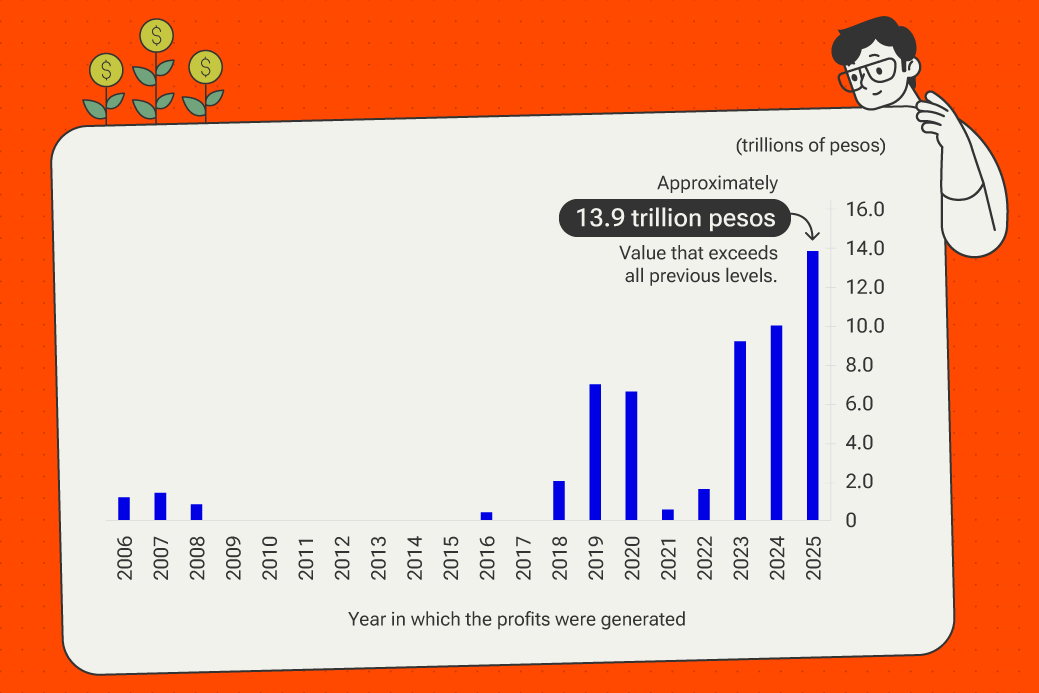
Each year, Banco de la República (the Central bank of Colombia) generates profits that, by law, must be transferred to the Government once the equity reserves in this same law have been deducted. In March of this year, Banco de la República will transfer to the National Government approximately 13.9 trillion pesos of profits generated by its operations during 2025. As shown in Graph 1, this level is the highest in history and exceeds the previous historical highs reached in 2023 and 2024.
Of the total profit for 2025, 86% can be attributed to the administration of foreign reserves during the past year. Foreign reserves are the country’s savings in foreign currency, which the Bank invests mainly in financial assets denominated in US dollars, although investments are also made in other currencies and gold. The Bank invests these reserves following three basic principles: safety, liquidity, and profitability. Consequently, most reserves are invested in highly safe financial assets, such as government bonds and securities issued by government-related entities that are economically sound. These investments enable the preservation of resource value and the generation of income without placing the country’s savings at risk.
As of December 31, 2025, net foreign reserves amounted to USD 66.3 billion, and their returns resulted from the interest earned on investments and their valuation gains.
In 2025, international interest rates remained relatively high, favoring bond performance. Moreover, these rates have been declining as global inflation has fallen, thereby increasing the value of the bonds. Added to the above was the strong performance of certain markets, such as gold, amid greater global uncertainty. Finally, the greater diversification of the portfolio, through increased investments in currencies other than the US dollar, contributed to the overall investment performance insofar as its assets increased in value and reduced portfolio risk.
Foreign reserves play a fundamental role in the economy. Their main function is to protect the country when access to foreign currency is difficult. Such difficulties arise during international financial crises, exports decline, the US dollar appreciates, or it is difficult to obtain external financing. In this way, the reserves serve as a backup, allowing Colombia to pay for its imports, meet its foreign-currency obligations, and respond to difficult scenarios without significantly affecting the national economy. In addition, reserves generate international market confidence, which facilitates access to credit and foreign investment.
Finally, it is worth noting that Colombia’s level of foreign reserves is adequate. As indicated in the most recent Foreign Reserves Management Report of Banco de la República, the current level of foreign reserves covers more than nine months of imports and also exceeds the country’s annual external debt service, including amortizations and interest. Its level falls within the adequate range, according to a comprehensive index recommended by the International Monetary Fund (IMF). When considered as a whole, these measures indicate that Colombia has sufficient coverage to withstand external shocks and meet its international obligations without exceeding what is required.