Hard-discount stores are a retail innovation that has brought significant changes to Colombia’s commercial landscape. Operating under well-known brands such as D1 and ARA, these stores are larger than neighborhood shops, but smaller than traditional supermarkets. They offer a limited assortment—mainly own-brand products—at comparatively lower prices. In addition to competing with traditional supermarkets, they also compete with neighborhood stores, as their business model allows rapid expansion in residential and urban areas where large retail chains typically do not operate.
For consumers, the benefits are clear: these stores deliver strong value for money. However, there is an ongoing debate about their broader impact on the local retail sector and labor markets. There is a concern that their entry could displace local businesses and reduce employment in affected areas.
A recent research paper published in the series Documentos de Trabajo sobre Economía Regional y Urbana by Banco de la República (the Central Bank of Colombia) co-authored by the Bank’s senior economist Andrea Otero-Cortés, examines this issue using detailed survey and administrative data. The study measures the impact of store openings on formal and informal employment as well as economic activity in medium-sized municipalities. Particularly, using econometric techniques, the authors compare the evolution of these variables where a new store opens with places where the opening occurs later. This quasi-experimental approach relies on the assumption that the order of store openings does not depend on variables different to those observed.
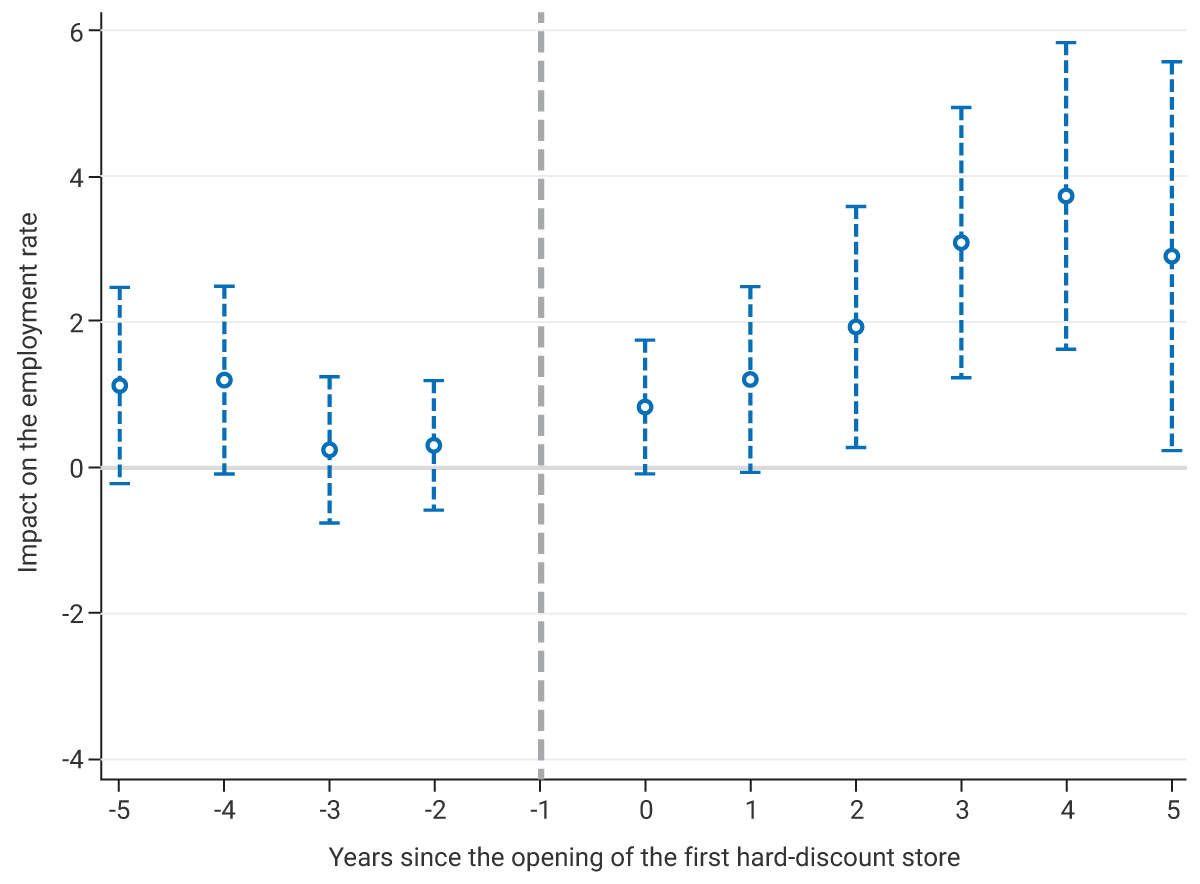
Graph 1 presents one key finding: the effect on local employment rates, based on data from Colombia’s national household survey (GEIH). The graph shows the difference in employment rates between treated municipalities in each year and its comparison group after the first store opens (marked by the vertical line). The bands around each point represent statistical confidence intervals.
As the figure shows, after the first store opens, municipal employment rates rise gradually, reaching statistical significance after three years. On average, five years after entry, the employment rate is about four percentage points higher than in municipalities without a hard-discount store. The authors also find positive effects on formal employment and tax revenue, suggesting greater labor formalization. By contrast, there is no clear negative effect on informal employment—a segment in which many neighborhood store owners operate.
The persistence of these effects suggests that the arrival of hard-discount stores in medium-sized municipalities generates lasting economic benefits through linkages with the local productive sector. In fact, the study finds that gains are concentrated in agriculture and manufacturing, which expand to meet increased demand for products sold in the new stores.