Servicios
|
Abstract
We use Long Short Term Memory (LSTM) neural networks, a deep learning technique, to forecast Colombian headline inflation one year ahead through two approaches. The first one uses only information from the target variable, while the second one incorporates additional information from some…
|
|
‘Apertura e integración de Colombia a la red mundial de comercio: mucho ruido y pocas nueces’
|
|
This paper tests for purchasing power parity (PPP) between Colombia and its main trading partners using the Johansen framework of multivariate cointegration. The tests shows that PPP does not hold in the strong sense, but a clear purchasing power relationship is, nevertheless, show to exist. The…
|
|
Banco de la República (the Central Bank of Colombia) announced that starting Monday, 14 July, Colombians will find the Bre-B Zone within the digital channels (such as mobile apps and websites) of various participating financial institutions, where they can register or confirm their Aliases. These…
|
|
Abstract
This document describes the evolution of the liquidity conditions of the Colombian public debt market, using a set of tools that capture several liquidity characteristics or dimensions. An indicator is proposed, which combines all these tools incorporating a broad set of information…
|
|
Presentación realizada durante el Comité consultivo de empresarios, en Cali.
|
|
Banco de la República (the Central Bank of Colombia), as per Law 1683 of 28 November 2013, issued a coin to commemorate the bicentenary of Cundinamarca's independence proclaimed on 16 July 1813.
|
|
Banco de la República (the Central Bank of Colombia), in accordance with Law 1956 of 04 June 2019, issued, for commemorative purposes and for one time only, the One Hundred (100) years of the Colombian Air Force (FAC in Spanish) coin.
|
|
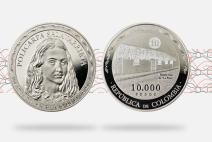
Banco de la República, in compliance with Law 1903 of 22 June 2018, makes available to the public, for commemorative purposes, the coin of the Bicentennial of the sacrifice of the national heroine Policarpa Salavarrieta. The coin will be available to the public as of 10 January 2023.
|
|
Banco de la República, in compliance with Law 1903 of 22 June 2018, makes available to the public, for commemorative purposes, the coin of the Bicentennial of the sacrifice of the national heroine Policarpa Salavarrieta. The coin will be available to the public as of 10 January 2023.
|
|
Banco de la República (the Central Bank of Colombia), in accordance with Law 1710 of 2014, issued a commemorative coin honoring Mother Laura. On the obverse, the coin has the image of Mother Laura designed based on the photograph exhibited at the Vatican on the day of her canonization (12 May 2013)…
|
|
It has a face value of COP 20,000, is of legal tender, and may be used for any monetary transaction for the equivalent of its face valueIn compliance with Law 2282 of 05 January 2023, BanRep will issue for commemorative purposes for one time only the 100th anniversary coin of Banco de la República.
|
|
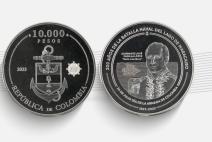
Banco de la República (the Central Bank of Colombia), in compliance with Law 2012 of 30 December 2019, will issue, for commemorative purposes and for one time only, the coin of the Battle of Lake Maracaibo and the Declaration of 24 July as the Colombian Navy Day.
|
|
Law 31 of 1992 empowers Banco de la República (the Central Bank of Colombia) to “order the mintage of legal tender coins in the country or abroad for commemorative or numismatic purposes, as provided for in special laws, establish their alloys, and determine their characteristics."
|
|
From: 2022
|
|
The Draft General National Budget (PGN for its Spanish acronym) for 2027 totals $575.7 trillion, a 3.6% increase over the 2026 budget of $555.8 trillion1. Of the total, $367.7 trillion is allocated to operating expenses, $90 trillion to investment, and $118 trillion2 to debt service.
|
|
Following the review by the Ministry of Finance and Public Credit, the Draft National General Budget for 2027 amounts to $634.9 trillion, an increase of $59.3 trillion compared with the initial draft submitted in July. Compared with the current 2026 appropriation of $555.8 trillion, the revised…
|
|
Comments by the Governor of Banco de la República on the Revised Draft National General Budget for 2027
|
|
I was very surprised to learn last night of the State Council’s decision to cancel the appointment of Alberto Carrasquilla as a member of the Board of Directors.Decisions taken by the judiciary are to be respected.Nevertheless, I would like to express my regret at this appointment, since it affects…
|
|
Este documento propone un modelo multisectorial de crecimiento, dinámico y estocástico que integra la literatura de ciclo económico real con la de economías con sectores en bonanza y enfermedad holandesa para analizar fluctuaciones, asignación de recursos y los cambios en precios relativos en una…
|
|
The world economy has recently been hit by commodity price fluctuations, with first round effects on noncore inflation and second round effects on core inflation. The policy response to commodity price fluctuations depends on the first and second round effects as well as on the strength of the…
|
|
A small open macroeconomic model, in which an optimal interest rate rule emerges to drive the inflation behavior, is used to model inflation within an inflation targeting framework. This set up is used to estimate the relationship between commodity prices shocks and the inflation process in a…
|
|
Presented at CVII Meeting of Central Bank Governors of CEMLA; Board of Governors and Assembly Meetings.
|
|
The opinions contained in this document are the sole responsibility of the author and do not commit Banco de la República or its Board of Directors.
|
|
The opinions contained in this document are the sole responsibility of the author and do not commit Banco de la República or its Board of Directors.
|