Servicios
|
The price setting behavior of Colombian retailers of goods and services was studied based on a unique dataset containing 12,052,970 individual price reports covering all items in the Colombian CPI from March 1999 to May 2008. The main results are summarized as follows: 1. Colombian consumer prices…
|
|
The opinions contained in this document are the sole responsibility of the author and do not commit Banco de la República or its Board of Directors.
|
|
We study the determinants of sovereign default risk in Colombia by focusing on different time spans of risk which are indicated by yield spreads of government bonds with different maturities. Cointegration regressions are performed to analyze whether the drivers of short-run default risk are…
|
|
This paper presents an estimation of expenditure needs and fiscal capacity of Colombia’s municipalities and departments in 2014. We use standard per capita norms to estimate the spending needs and data envelopment analysis for the local fiscal capacity.
|
|
The long-run component of the Colombian unemployment rate is estimated for the last twenty years. According to the results, the main determinants of the permanent component of the unemployment rate are the real hourly wage, the non-wage labor costs and the rate of capital accumulation. Given the…
|
|
The Colombian economy experienced several shocks in the past ten years. The permanent fall of inflation, the adoption of inflation targeting (IT) and a financial crisis altered the transmission mechanism of monetary policy. Low inflation and IT reduced inflation persistence and contributed to…
|
|
We assess the effects of the Colombian Unemployment Subsidy (US) program on future labor participation, unemployment, formality, school attendance and earnings of its beneficiaries, on household earnings and school attendance of the household members, and on weight and height of their children at…
|
|
We analyse three models to determine the conditions under which reserve requirements are used as a part of an optimal monetary policy framework in an inflation targeting regime. In all cases the Central Bank (CB) minimizes an objective function that depends on deviations of inflation from its…
|
|
This year, Banco de la República will have a special celebration every month, on the occasion of its first 100 years of existence, a time in which it has played a fundamental role in the stability of the Colombian economy and in the cultural promotion in the country.
|
|
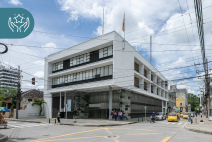
Bogotá (Bogotá, D. C.; Cundinamarca)
|
|
Our corporate portal www.banrep.gov.co will be undergoing scheduled maintenance starting at 7:30 p.m. on Friday, May 7. As a result, the services on the website will be intermittent, possibly presenting errors in the queries made throughout the night. Please take the necessary measures to reduce…
|
|
Notes by the Governor of Banco de la República (the Central Bank of Colombia), Leonardo Villar-Gómez, at the launching of the reissuing of the 1986 Chenery Employment Mission Report, “Misión de empleo. Informe final, julio 1986”.Above all, the reissuing of the 1986 Chenery mission report is a…
|
|
Article published in the Project Synsicate magazine on April 5th, 2019.
Original article
|
|
Presentation titled "Timing and Duration of IT Regimes", delivered during the Seminar of the EEP Journal (Essays on Economic Policy), organized by Banco de la República at the Events Center of Biblioteca Luis Ángel Arango in Bogotá, Colombia.
|
|
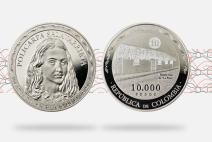
Banco de la República announces the release of a commemorative coin marking the 500th anniversary of the founding of the city of Santa Marta.The obverse of the coin features the image of the Casa de la Aduana alongside the El Morro islet and its lighthouse, framed by a geometric-patterned border.
|
|
During the 1920s, the Colombian economy experienced the highest rate of growth in its history. The economic reforms of 1923 (the central bank, gold standard, banking legislation, fiscal reorganization), the coffee boom, and the unprecedented influx of foreign capital were the driving forces behind…
|
|
Infrastructure, Society, Economics and Culture: Lessons from the History of Large Technological Systems, Universidad de los Andes, December 5, 2017
|
|
We develop a small open economy model with sectorial balance sheets that are exchange rate exposed and with sectorial stock and flow consistency. The model is perturbed by a shock to investor sentiment and a sudden stop to capital inflow. It is used to evaluate the claims that usually back the fear…
|
|
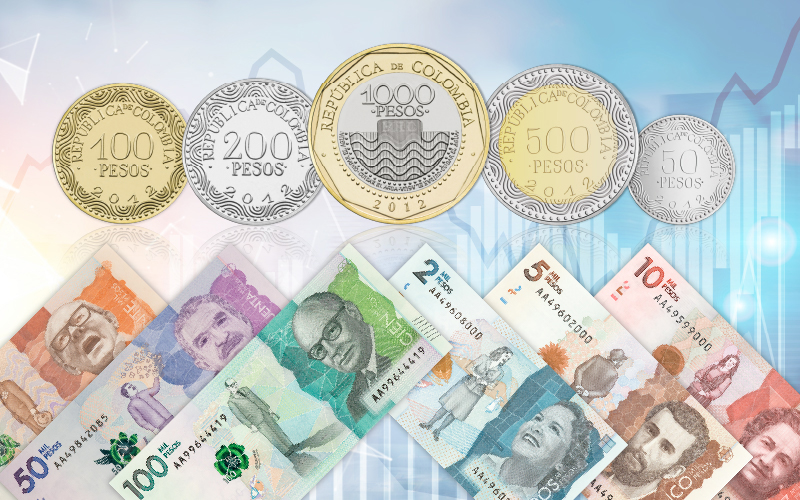
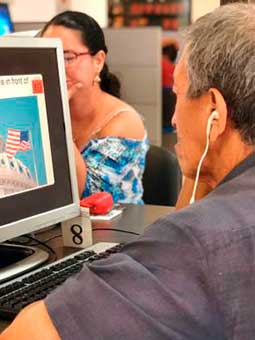
Banco de la República (the Central Bank of Colombia) provides virtual training for the public in general, and to blind or deaf people, giving them the necessary support. These trainings aim to teach how to properly identify and check the security features of the new family of Colombian banknotes.…
|
|
Banco de la República (the Central Bank of Colombia) is constituted as a legal person of public law, with constitutional status and administrative, equity, and technical autonomy, subject to its own legal framework as established in Articles 371 to 373 of the Political Constitution, Law 31 of 1992,…
|