Speeches at Banrep’s 100 years Academic Event - Discussion Sessions and Launch of a Collection of Books and Historical Statistical Series of Colombia
These documents are of an informative and academic nature. Opinions and possible errors are the sole responsibility of the author(s) and their contents are not binding on Banco de la República or its Board of Directors.
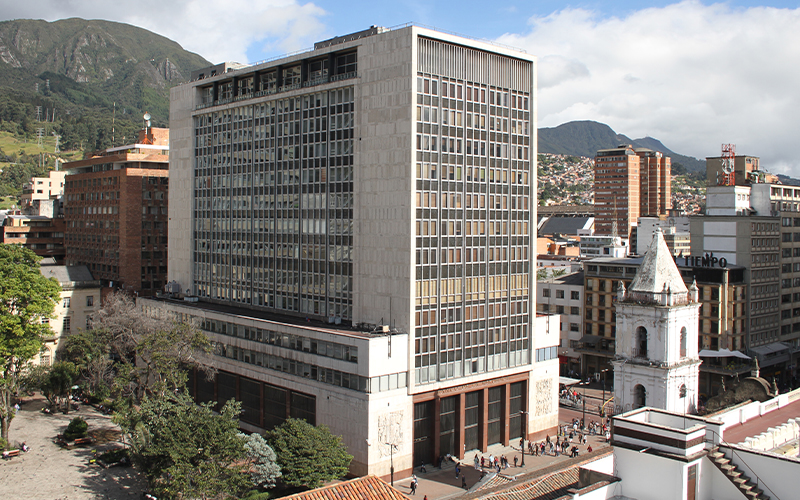
Good morning to all, and thanks for joining us in this event, which is a very important part of the activities we have been planning since last year to celebrate the centenary of Banco de la República (the Central Bank of Colombia, Banrep). I will begin by saying that we are holding this event in this old Treasury room because we want to re-inaugurate it as a meeting place for academic activities.
These one hundred years since the founding of Banco de la República have also been a time to build confidence and a very solid institutional framework, as stated in the slogan we have been using in all our celebrations. This framework has been strong ever since the creation of the Bank, which followed the parameters proposed by the Kemmerer Mission in 1923, becoming even stronger with the 1991 Constitution, when Banco de la República became an autonomous institution with a very clear mandate to ensure the purchasing power of the currency in coordination with the Government to promote sustainable growth-and here I emphasize the word sustainable-of economic activity and employment.
The autonomy granted to Banco de la República by the 1991 Constitution, as well as the clarity of the mandate given to it, help to understand a great paradox. I am referring to the fact that the Bank is at the same time one of the organizations with the best public perception in Colombia, while also being a strongly unpopular and criticized institution whenever the Board of Directors of the Bank must make painful decisions that generate significant short-term costs in order to maintain medium- and long-term stability.
It was precisely to better manage this apparent inconsistency between short- and long-term costs and benefits that Banco de la República was granted the autonomy that allows it to act with a broader time perspective than typically enjoyed by the governments in power and even by public opinion itself.
Many of the activities we have developed to celebrate the Bank’s 100 years of history, both in Bogotá and in other cities of the country, have taken advantage of the presence we have in the country through our cultural activities. Today we want to place a different emphasis, explicitly honoring the technical work and economic research work carried out at the Bank.
On this matter, as you know very well, we have one of the most outstanding research teams in the world. This was highlighted in the analysis conducted last year by Central Banking magazine (August 2022). Based on publications in international Journals of high academic accreditation, Central Banking ranked the research group of Banco de la República as the best in Latin America and among the seven best of all central banks in the world (it is ranked number 14, but it includes multilateral institutions such as the IMF and the Bank for International Settlements in Basel and several state banks of the US Federal Reserve).
The activities we will be having this morning are, I repeat, a tribute to the entire staff of researchers and economists that Hernando Vargas has been leading at the Office of the Deputy Technical Governor for 18 years. Aside from the academic excellence reflected in the publication rankings, this team forms the basis for the work carried out by the Board of Directors in its decision-making process.
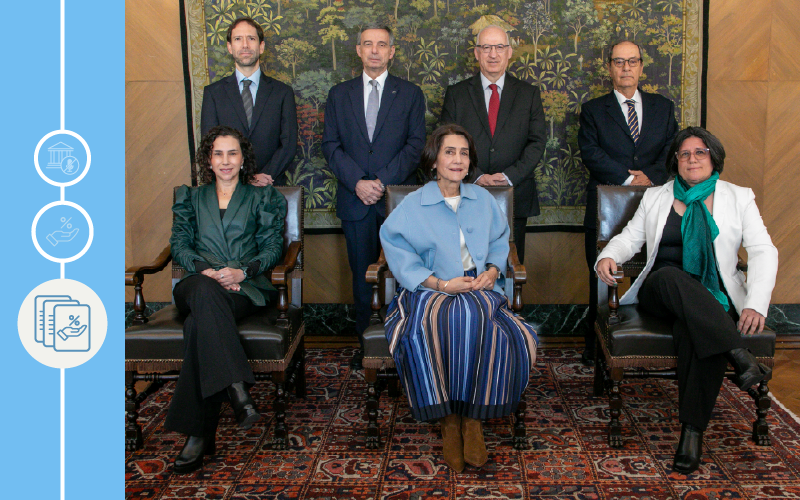
A few days ago, a book by Gloria Valencia on the history of the Board of Directors of the Bank since the 1991 Constitution was relaunched. The discussion on the performance of the Board evidenced a very clear consensus on the fundamental importance of the analyses carried out by the technical staff, as well as on the practice of not making decisions on issues on which the technical staff has not previously prepared a document. This, of course, does not prevent the Board from occasionally adopting decisions different from those recommended by the technical staff; however, it does imply that the Board obliges itself to weigh very judiciously the arguments developed by the staff for or against any decision to be made. This procedure has been extremely valuable in enriching the quality of the decisions adopted by the Board.
I will briefly refer to the activities we will have this morning, starting with the last one, which will take place at the end of the morning. It will be a discussion session on “Challenges of Central Banking in the 21st Century”, which will be moderated by Roberto Steiner and will include the participation of three of the most outstanding researchers in macroeconomics and monetary policy currently available worldwide: Hélene Rey, professor at the London Business School; Yuriy Gorodnichenko, from the University of California at Berkeley; and José-Luis Peydró, from the Imperial College of London.
Before this international discussion session, we will have two more sessions on the history of Banco de la República and the economic history of Colombia in the last one hundred years, which will be moderated by José Darío Uribe, whom you all know. The discussion will be organized around two very important books that we are launching today.
The first one is an update of the book edited by “Jota” Uribe himself in 2015 on the history of Banco de la República, which at that time was 92 years old. Jota accepted the challenge of acting as editor again in a version that includes the most recent years. It also includes a chapter on exchange rate regimes and financial globalization by Juan José Echavarría, and another on Banco de la República in the COVID-19 pandemic by Pamela Cardoso, Fernando Tenjo, and Hernando Vargas.
The second discussion session, also moderated by Jota Uribe, is about a book that we were able to publish thanks to the support of the CAF (Development Bank of Latin America), an institution to which I would like to express our most sincere thanks through Carolina Camacho, who is here on behalf of its Executive President, Sergio Diaz-Granados. This book contains five essays on economic history of great importance for the reflection on the role played by the Bank since its foundation. The first four essays were written by authors who, besides being widely recognized as historians, have also been important figures for Colombia’s economic policy and have been directly linked to the Bank and its Board of Directors. They include José Antonio Ocampo, Miguel Urrutia, Antonio Hernández-Gamarra, and Carlos Caballero-Argaez, who is accompanied in his article by Pilar Esguerra. The fifth essay in this book has a more Latin American perspective, and was written by Luis Jácome, who was General Manager of the Central Bank of Ecuador and is currently linked to the International Monetary Fund, and by Samuel Pienknagura, senior economist at The World Bank.
Before starting the sessions on the two books I have just mentioned, we are also going to launch the virtual editions of nine books published physically by the Bank in the past and that, given their importance for the economic history of the country and of the Bank itself, we consider important to make them available to anyone on our website. María Teresa Ramírez, who has become the Bank’s reference researcher on historical topics, will make a short presentation of these nine books and the reasons why they were chosen for virtual reprinting.
Finally, I would like to take the opportunity of these opening words to present a new statistical product that the Bank has developed within the framework of its centennial, which we have called "The Historical Statistical Series of Colombia". These historical series will be available starting today to all researchers of the Colombian economy and to the public through a site on the Bank’s website (only available in Spanish). This site compiles Colombia’s main historical statistical series organized in nine thematic reports, including gross domestic product, prices and inflation, interest rates, among others.
For the development of this product, the data series were taken as far back in history as possible. The GDP series, for example, begins in 1905, the CPI series in 1954. A great effort was made to make the different sources and versions compatible. In addition to the splicing, some series were completed, and others could be built with a higher time frequency. All series are available together with their respective metadata and methodological notes. The site and data will be constantly updated and will be a valuable resource for research and the community at large. I invite you to start using it today.
Once again, thank you all for joining us. Many thanks to the CAF for their support for this event and, above all, for the preparation and publication of the book I have already referred to.