Report on the Evolution of the Balance of Payments and the International Investment Position – Second Quarter of 2026

The quarterly report on the performance of Colombia’s balance of payments and the international investment position outlines the main results for the country’s current and financial accounts, as well as the evolution of their items.

 See the report (only in Spanish)

Publication Date:

1. Overall Results for the Balance of Payments

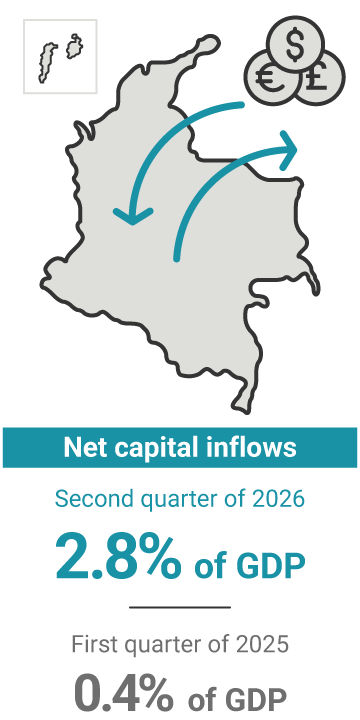
During the second quarter of 2026, Colombia’s current account of the balance of payments registered a USD 4,702 million (m) deficit, equivalent to 3.5% of the quarterly Gross Domestic Product (GDP). In turn, the financial account, including the variation in foreign reserves (USD 550 m), recorded net capital inflows for USD 3,719 m (2.8% of quarterly GDP). Errors and omissions were estimated at USD 983 m.

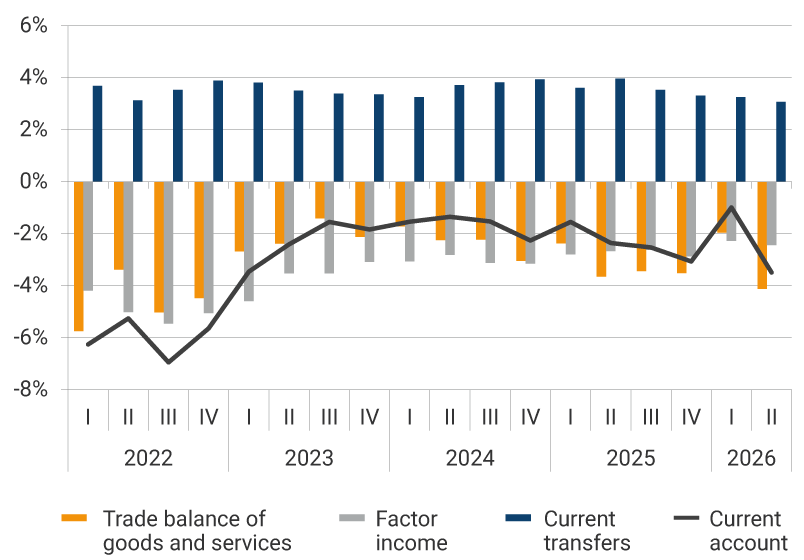
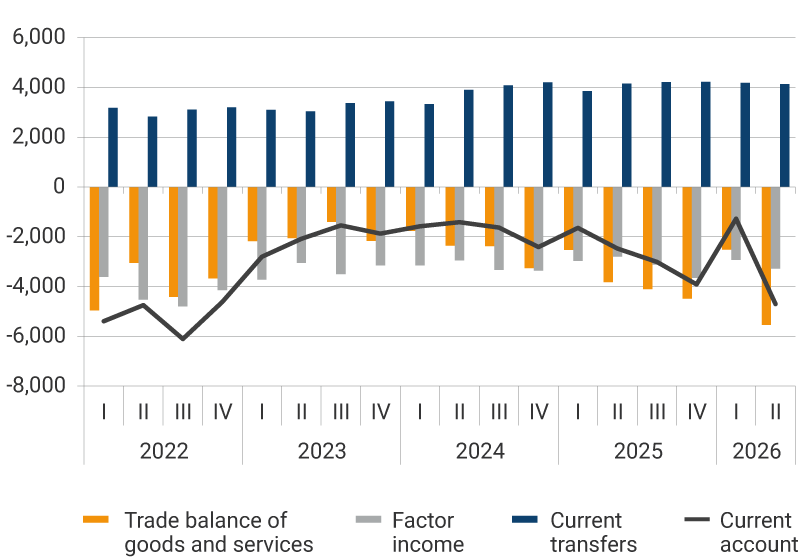
By components, the current account deficit (USD 4,702 million) in the second quarter of 2026 was driven by deficits in the trade balance for goods amounting to USD 4,915 million, in factor income amounting to USD 3,287 million, and in the services trade balance amounting to USD 631 million. These results were partially offset by net income from current transfer of USD 4,131 million (Graph 1).

Graph 1. Components of Colombia’s Current Account of the Balance of Payments
Figures in millions of U.S. dollars
A bar and line chart showing quarterly data from 2022 through the second quarter of 2026, with figures in millions of dollars. The chart displays four series: the trade balance in goods and services (orange bars), which remains negative throughout the period, reaching deficits of nearly −$6 billion. Factor income (gray bars) is also negative for the entire period, fluctuating between approximately −$2 billion and −$5 billion. Current transfers (blue bars) are consistently positive, rising from nearly $3 billion in 2022 to over $4 billion by 2025. The current account (black line) combines these components and remains in negative territory throughout the period. It shows a deeper deficit in 2022—close to −$6 billion—followed by a partial recovery in 2023, a decline again in 2025, a recovery in 2026, and a subsequent drop to −$4.7 billion.
Figures as a percentage of GDP
A bar and line chart showing quarterly data from 2022 through the second quarter of 2026, with figures expressed as a percentage of GDP. The chart displays four series: the trade balance in goods and services (orange bars), which remains negative throughout the entire period, ranging between approximately −3.5% and −6% of GDP; factor income (gray bars), also negative, fluctuating between roughly −2% and −5% of GDP; current transfers (blue bars), which are consistently positive and stable, remaining between 3% and 4% of GDP; and the current account (black line), which stays in deficit throughout the years. It begins with a larger deficit in 2022—close to −7% of GDP—followed by a moderate recovery between 2023 and 2024, a subsequent deterioration toward 2025, and a recovery in 2026, before declining once again to −3.5%.

Source: Banco de la República (the Central Bank of Colombia)

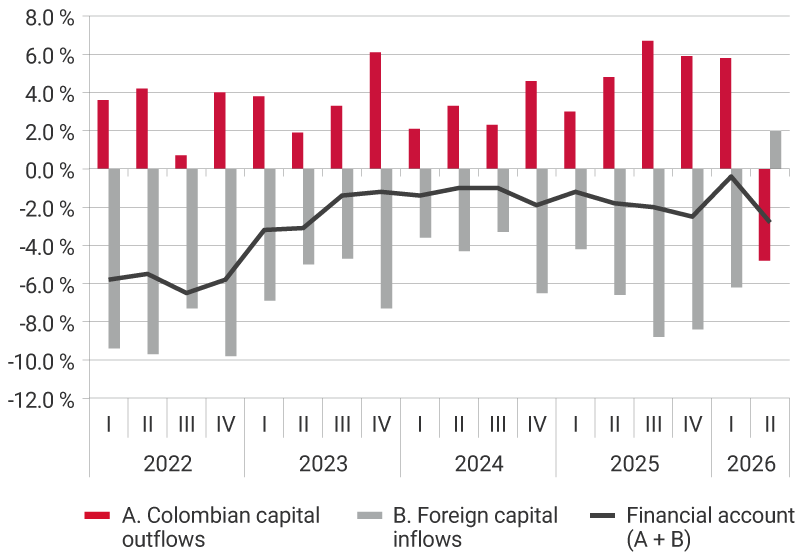
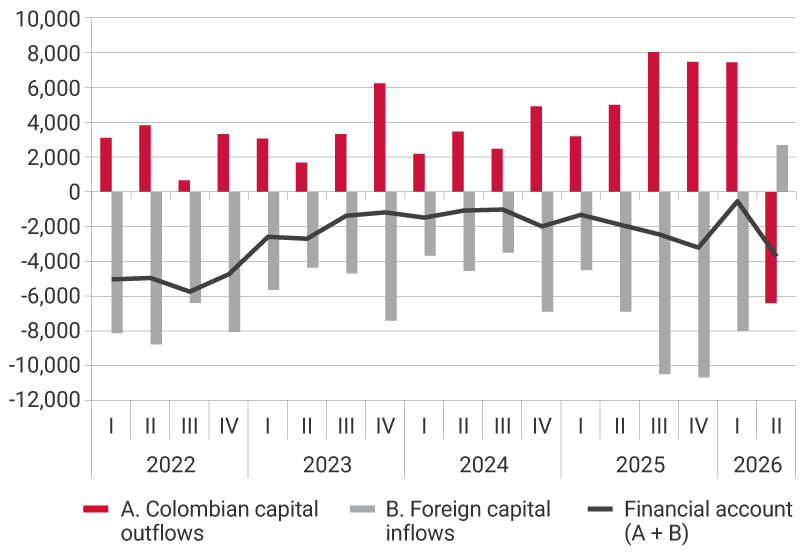
As for the financial account for the second quarter of 2026, net capital inflows are estimated at USD 3,719 m, corresponding to foreign capital inflows (USD 6,149 m), Colombian capital outflows (USD 804 m), payments from non-residents to residents for gains on financial derivatives transactions (USD 2,683 m), and the increase in foreign reserves resulting from balance of payments transactions (USD 550 m) (Graph 2).

Graph 2. Components of the Financial Account of Colombia's Balance of Payments
Figures in millions of U.S. dollars
Bar and line graph, with quarterly data from 2022 to the second quarter of 2026, figures in millions of dollars. The graph shows three series: A. Colombian capital outflows (red bars), with positive values ​​throughout the period, except in the last quarter. These outflows gradually increase throughout the period, with peaks exceeding $8 billion in 2025. B. Foreign capital inflows (gray bars), with negative values ​​throughout the period, except in the last quarter. Magnitudes vary between −3,500 and around −10 billion, with further declines in 2025. Financial account (A + B) (black line), which ranges between balances close to −500 and −6 billion dollars. It starts from a deterioration in 2022, followed by a partial recovery between 2023 and 2024 before falling again in 2025, a recovery in 2026 and finally falling to -3.7 billion.
Figures as a percentage of GDP
A bar and line chart presenting quarterly data from 2022 through the second quarter of 2026, with figures expressed as a percentage of GDP. The chart displays three series: A. Outflows of Colombian capital (red bars), which show positive values ​​throughout the entire period—except for the final quarter—with moderate fluctuations toward 2024 and 2026. B. Inflows of foreign capital (gray bars), which show negative values ​​throughout the entire period—again, with the exception of the final quarter—with the largest inflows observed in 2022 and 2025. The financial account (A + B) (black line) reflects negative balances. It remains between 0% and −6.5% of GDP, beginning with a deterioration in 2022, followed by a partial recovery during 2023 and 2024, a slight downward trend in 2025, a recovery in 2026, and a final decline to −2.8%.

Note: Following the sixth edition of the International Monetary Fund’s Balance of Payments Manual, the financial account is presented with the same sign as the current account. For example, if the current account is in deficit, the financial account is negative, indicating that the economy resorts to external financing and/or liquidates its external assets to finance its excess current expenditure.
Source: Banco de la República


2. Quarterly and Annual Evolution of the Current and Financial Accounts of Colombia’s Balance of Payments

(a) Current Account

The estimated current account deficit for the second quarter of 2026 (USD 4,702 million, equivalent to 3.5% of quarterly GDP) widened by USD 3,424 million compared with the immediately preceding quarter. This performance was mainly driven by the larger deficit in the trade balance for goods and services, the increase in net factor income outflows, and the reduction in the surplus of current transfers (Graph 1).

For the January-June 2026 period, the current account deficit (USD 5,981 million, equivalent to 2.3% of semiannual GDP) was USD 1,854 million higher than in the same period of 2025. This outcome is explained by the widening deficit in the trade balance for goods and services and the increase in net factor income outflows, partially offset by higher net inflows from current transfers.
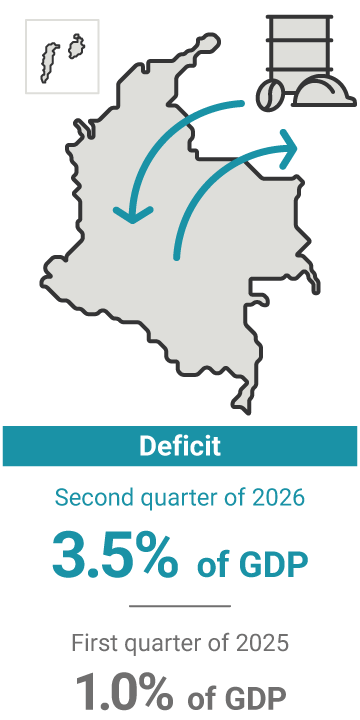
The current account deficit in the second quarter of 2026 represented 3.5% of GDP. In the previous quarter, it was 1.0%.

(b) Financial Account

Net capital inflows of USD 3,719 million (2.8% of GDP) recorded in the financial account during the second quarter of 2026 increased by USD 3,173 million compared to the immediately preceding quarter. This result is explained by reductions in foreign financial assets, higher net inflows of foreign direct investment, and net disbursements of external loans and other credit, partially offset by net liquidations of portfolio investment instruments.
During the first half of 2026, the financial account (USD 4,265 million, equivalent to 1.6% of GDP) recorded higher net capital inflows of USD 1,047 million compared with the same period of 2025. This performance is mainly explained by higher net inflows of foreign direct investment, as well as larger liquidations of deposits held abroad and higher net disbursements of external loans and other credit, partially offset by net liquidations of portfolio investment instruments.

Net capital inflows in the second quarter of 2026 accounted for 2.8% of GDP. In the previous quarter, they were 4.0%.

3. International Investment Position (IIP)

As of the end of March 2026, Colombia recorded a negative net international investment position of USD 203,566 m (42.5% of annual GDP), resulting from assets of USD 314,487 m (65.6% of annual GDP) and liabilities of USD 518,052 m (108.0% of annual GDP). Of the total asset balance, 37.9% corresponds to portfolio investments, 26.4% to Colombian direct investment abroad, 21.2% to reserve assets, and the remaining 14.5% to other assets, including loans, other foreign credits, deposits abroad, and financial derivatives. Liabilities are broken down into 56.4% foreign direct investment, 23.6% portfolio investment, and the remaining 19.9% other liabilities (where external loans stand out).

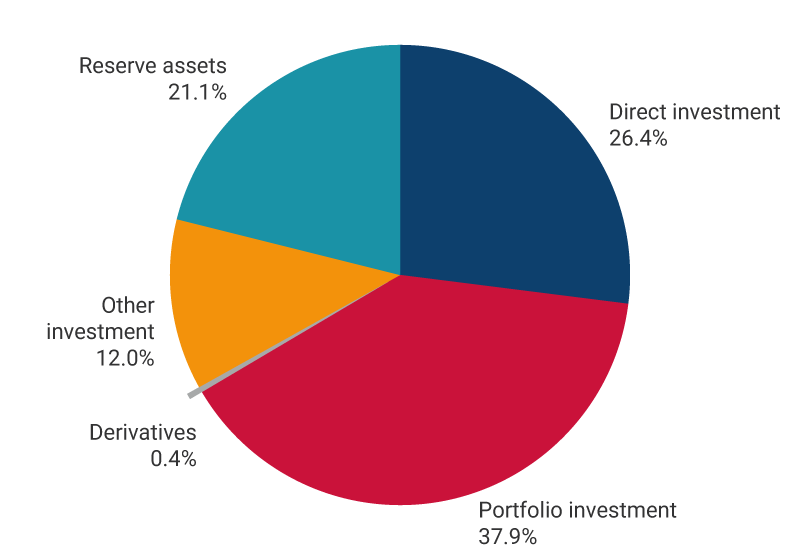
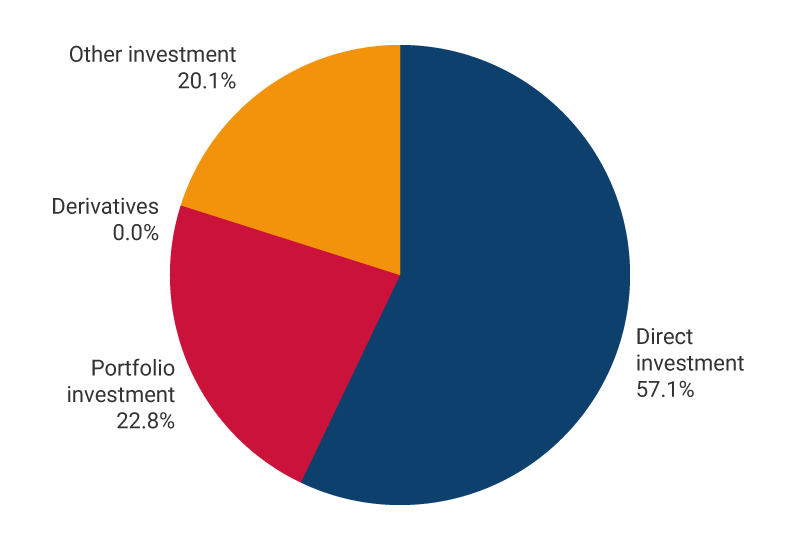
As of the end of June 2026, Colombia recorded a negative net international investment position of USD 204,240 m (40.0% of annual GDP), resulting from assets of USD 316,853 m (62.1% of annual GDP) and liabilities of USD 521,093 m (102.2% of annual GDP). Of the total asset balance, 39.5% corresponds to portfolio investments, 27.0% to Colombian direct investment abroad, 21.1% to reserve assets, and the remaining 12.4% to other assets, including loans, other foreign credit, deposits abroad, and financial derivatives. Liabilities are broken down into 57.1% foreign direct investment, 22.8% portfolio investment, and the remaining 20.1% other liabilities, (where external loans stand out).

Graph 3. International Investment Position as of June 2026 (USD 204,240 m, 40% of GDP 1)

Assests
USD 316,853 m
The chart shows the percentages of assets within the international investment position as of June 2026. Direct investment, 27.0%. Portfolio investment, 39.5%. Derivatives, 0.4%. Other investment, 12.0%. Reserve assets, 21.1%.
Liabilities
USD 521,093 m
The chart shows the percentages of liabilities in the international investment position as of June 2026. Direct investment, 57.1%. Portfolio investment, 22.8%. Derivatives, 0.0%. Other investment, 20.1%.

1 The GDP figure in U.S. dollars corresponds to the sum of the last four quarters.

Report on Evolution of the Balance of Payments and International Investment Position (Complete issues - available since 2023)

This report describes the main results of the quarterly and annual evolution of the country's balance of payments.

Report on the Evolution of the Balance of Payments and International Investment Position - Third Quarter 2023 Download (only in Spanish)Balance of Payments Statistics (only in Spanish)
Report on the Evolution of the Balance of Payments and International Investment Position - Fourth Quarter of 2024 Download (only in Spanish)Balance of payments statistics (only in Spanish)
Report on the Evolution of the Balance of Payments and International Investment Position – Third Quarter of 2024 Download (only in Spanish)Balance of payments statistics (only in Spanish)¿Cómo encontrar las series sobre la Balanza de Pagos en el nuevo Portal de Esta…
Report on the Evolution of the Balance of Payments and International Investment Position - Second Quarter of 2024 Download (only in Spanish)Balance of payments statistics (only in Spanish)
Report on the Evolution of the Balance of Payments and International Investment Position – First Quarter of 2024 Download (only in Spanish)Balance of payments statistics (only in Spanish)
Report on the Evolution of the Balance of Payments and International Investment Position - Fourth Quarter 2023 Download (Only in Spanish)Balance of payments statistics (Only in Spanish)

Note 01 September 2021: Current account statistics of the balance of payments were revised from 2015 to 2020 as a result of: i) the findings of the reconciliation exercise of external sector statistics and net lending of financial accounts published by Banco de la República and the Rest of the World Account of the System of National Accounts (SNA) disclosed by the National Administrative Department of Statistics (DANE in Spanish) that evidenced differences in the values of free trade zone exports; and ii) improvements in the sources of information and estimation methods implemented by Banco de la República between 2015 and 2020. As a result of the above, the current deficit was revised downward between 0.07 percentage points (pp) and 0.2 pp of Gross Domestic Product (GDP) in dollars for the periods 2015 and 2017. On the other hand, for the years 2018 to 2020, the revision implied an increase in the deficit level between 0.16 pp and 0.18 pp of GDP in dollars. The details of this revision can be consulted in the Statistical Review document of the current account of Colombia’s Balance of Payments. Statistical Review document of the current account of Colombia’s Balance of Payments (Only in Spanish).