National Financial Accounts Bulletin by Institutional Sector - Third Quarter 2023
Below is a summary of the financial accounts by institutional sector and by financial instrument. For further details, please refer to the Technical Bulletin.
Saving-investment flows for the third quarter of 2023
1. By institutional sector
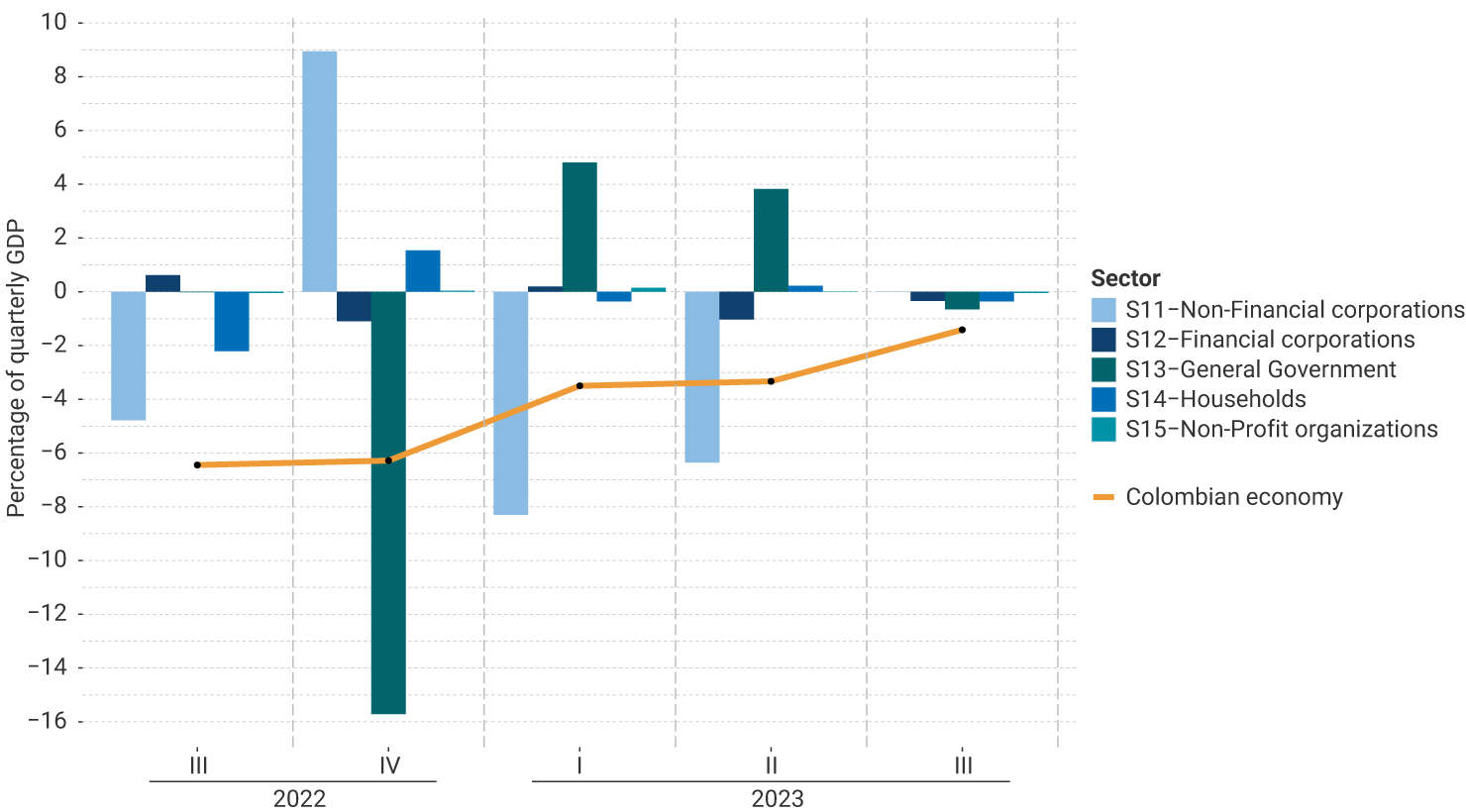
According to the Financial Accounts calculated by Banco de la República (the Central Bank of Colombia), in the third quarter of 2023, the current account deficit of the Colombian economy reached 1.4% of the quarterly Gross Domestic Product (GDP), compared to 6.4% in the same period of 2022. This is mainly explained by the deficits of the National Central Government (0.7%) and Households (0.4%).
Graph 1. Current Account Deficit of the Colombian Economy and Savings and Investment Balances by Institutional Sector, 2022 III - 2023 III
Source: Banco de la República - Financial Accounts
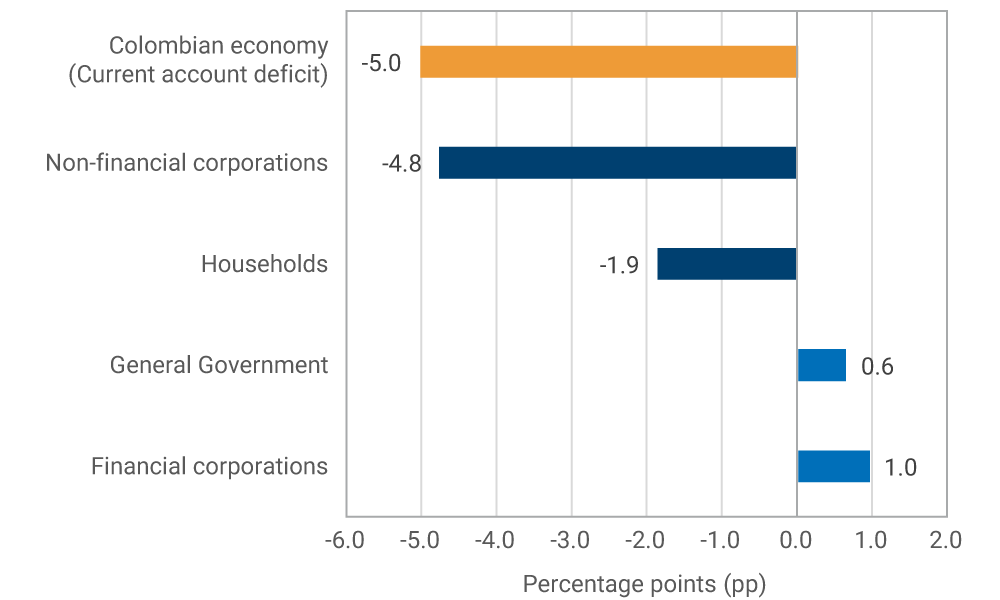
Compared to the third quarter of 2022, financing needs decreased by 5.0 pp. This was mainly explained by the lower net financing needs of Non-Financial Corporations (4.8 pp.) and by the lower net debt of Households (1.9 pp.). These changes were partially offset by the decrease in the flow of net assets of Financial Corporations (-1.0 pp.), which went from registering a surplus of 0.6% to a deficit of 0.3% of quarterly GDP, and by the higher net financing needs of the General Government (-0.6 pp).
Graph 2. Explanation of the Change in the Colombian Economy’s Savings-Investment Balance by Institutional Sector, 2022 III - 2023 III
Source: Banco de la República -Financial Accounts
2. By financial instrument / net external financing
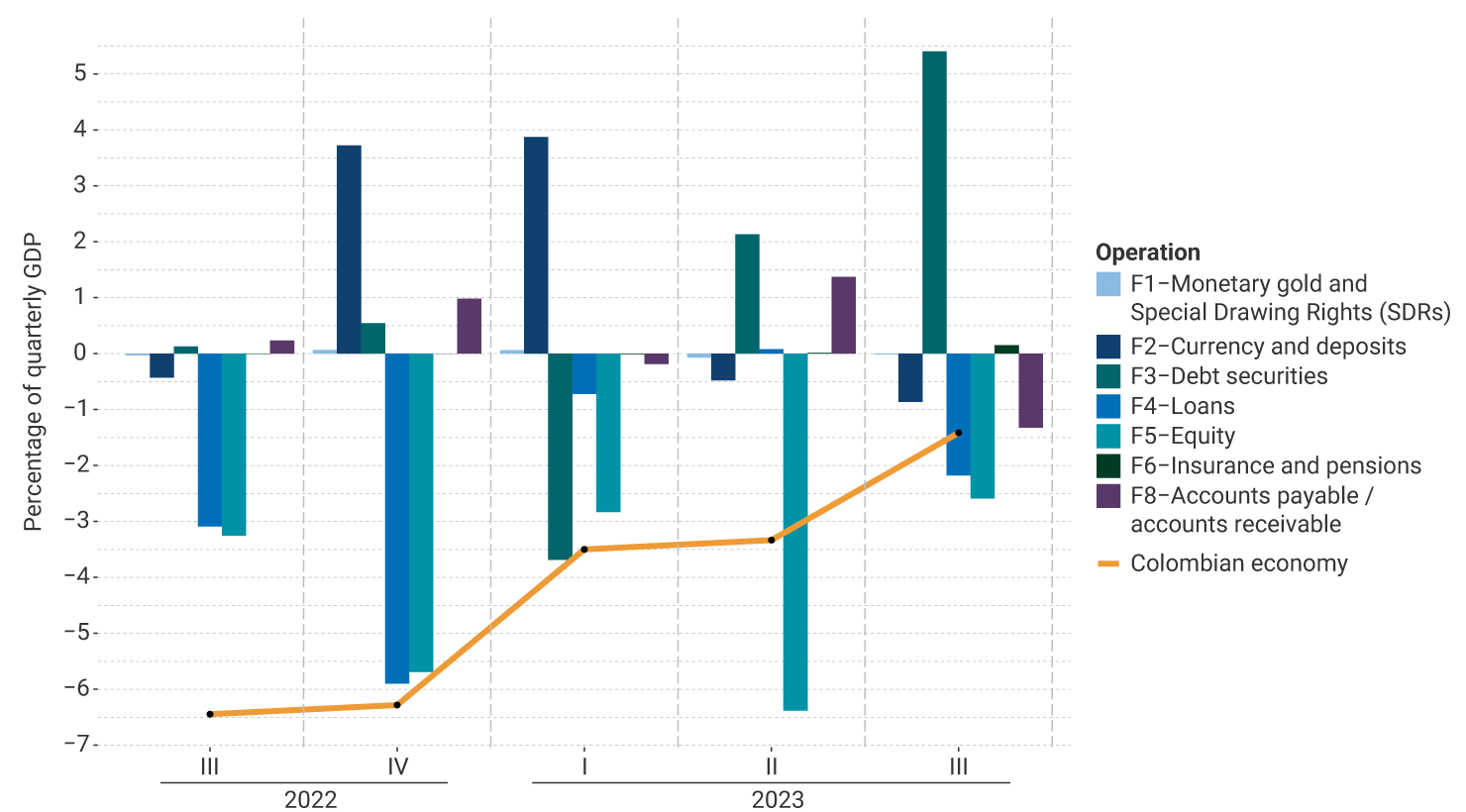
The negative quarterly savings-investment balance of the Colombian economy was covered by net external financing flows equivalent to 1.4% of quarterly GDP. Net inflows of financial resources from the rest of the world were channeled mainly through foreign direct investment and other equity investments (F5) of 2.6% and through loans (F4) of 2.2%. This was offset by an increase in debt securities (F3) by 5.4% of quarterly GDP.
Graph 3. Net External Financing of Colombia’s Savings-Investment Balance by Financial Instrument, 2022 III - 2023 III
Source: Banco de la República - Financial Accounts
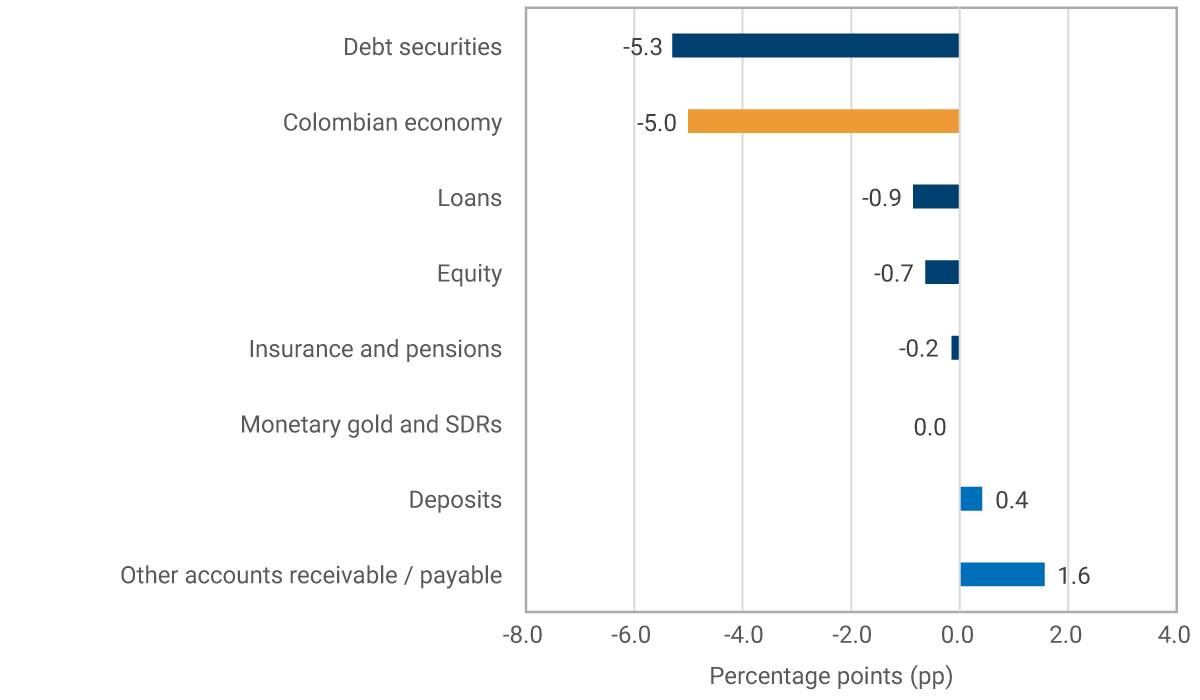
Compared to the third quarter of 2022, the decrease in external debt flows was mainly explained by the increase in the acquisition of debt securities (F3) by 5.3 pp. and by the decrease in loans (F4) by 0.9 pp. This was partially offset by an increase in external financing in terms of accounts receivable or payable by 1.6 pp. and by the greater disaccumulation of deposits (F2) (0.4 pp.).
Graph 4. Explanation of the Change in the Colombian Economy’s Savings-Investment Balance by Financial Instrument, 2022 II -2023 II
Source: Banco de la República - Financial Accounts
Financial Account Balances for the third quarter of 2023
1. Net financial position by institutional sector
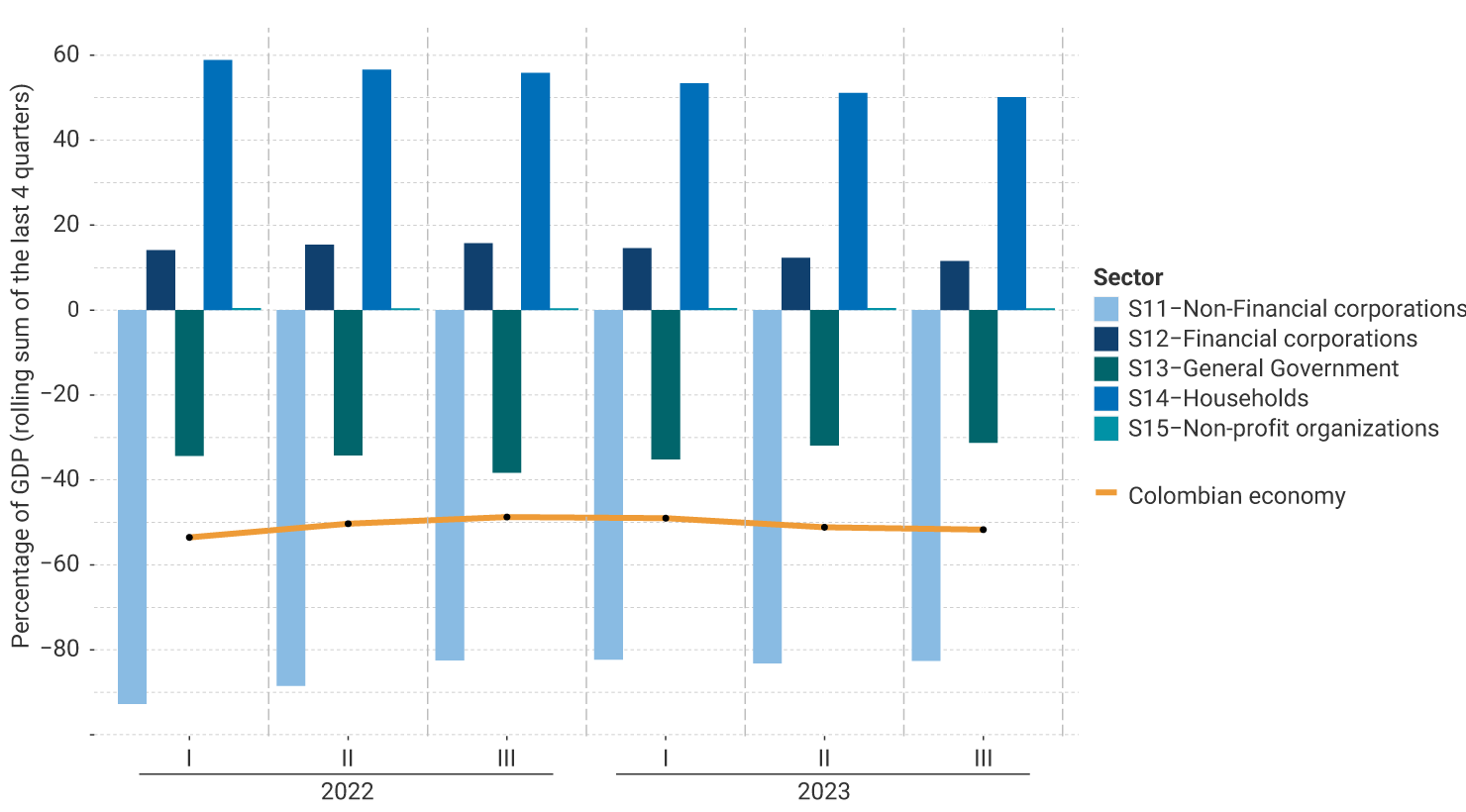
At the end of the third quarter of 2023, the Colombian economy recorded a net debtor position with the rest of the world equivalent to -51.7% of annual GDP. This is explained by the net debtor position of Non-Financial Corporations (-82.6%) and the General Government (-31.2%). This was partially offset by the net creditor positions of Households (50.1%) and Financial Corporations (11.6%).
Compared to the third quarter of 2022, there was an increase of 1.4 pp in the external debtor position of the economy, explained by the reduction in the creditor position of Households (6.5 pp) and Financial Corporations (3.8 pp). These changes were partially offset by the decrease in the net debtor positions of Non-Financial Corporations (5.9 pp) and the General Government (3.0 pp).
Graph 5. Colombia’s Net Financial Position by Institutional Sector, 2022 III -2023 III
(percentage of annual nominal GDP*)
Source: Banco de la República - Financial Accounts
2. Net external position by financial instrument
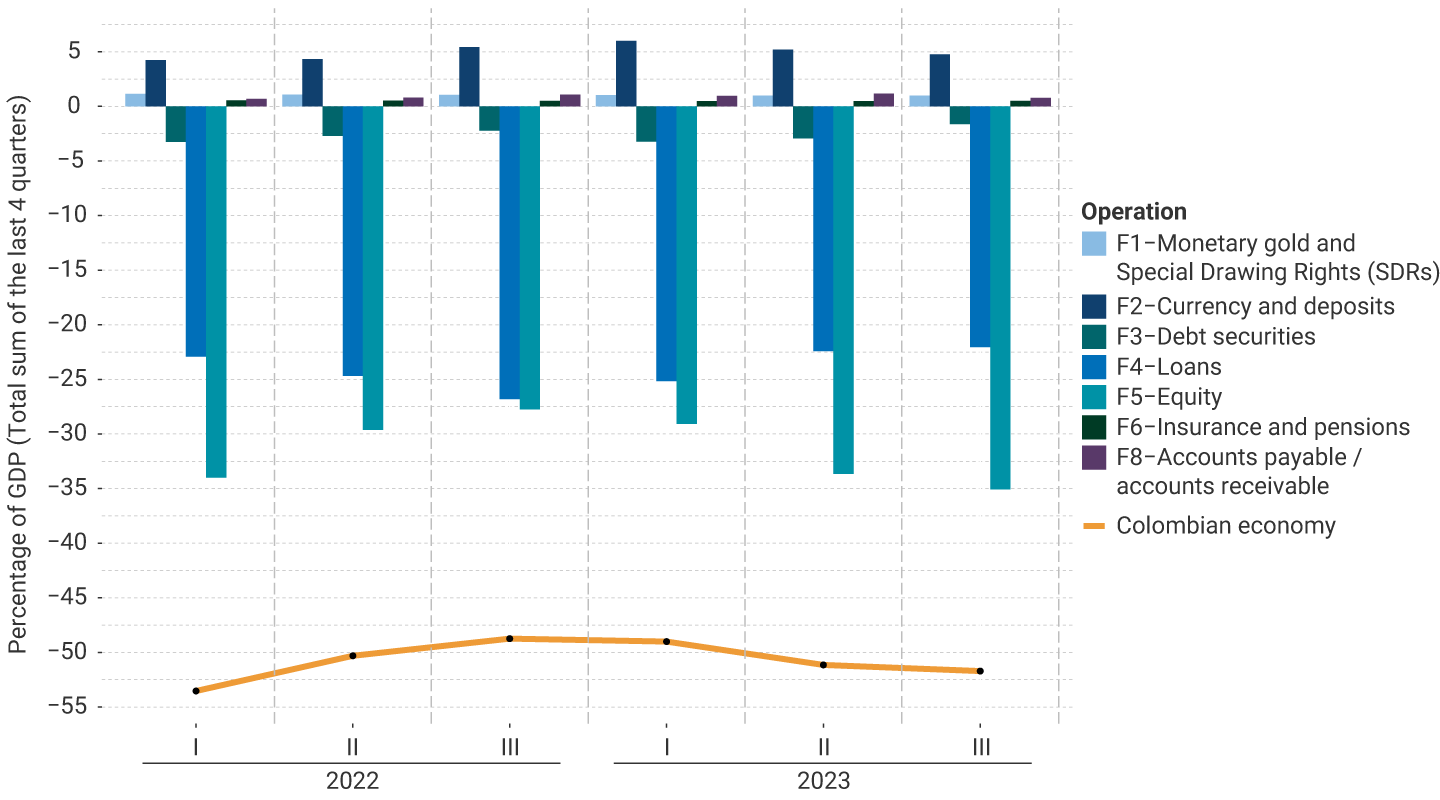
At the end of the third quarter of 2023, the net debtor position of the Colombian economy with the rest of the world was mainly represented by equity (F5) of -35.1% and loans (F4) of -22.0% of annual GDP. This was partially offset by Colombian foreign holdings of deposits (F2) of 4.8% and Net accounts receivable or payable (F8) of 0.8%.
Compared to the third quarter of 2022, the increase in the economy’s net debtor position by 1.4 pp was mainly due to the higher level of net debt through foreign direct investment and other equity investments by 5.5 pp.
Graph 6. Net External Financial Position of the Colombian Economy by Financial Instrument, 2022 III - 2023 III
(percentage of annual nominal GDP*)
Source: Banco de la República - Financial Accounts