Labor Market Reports - Recent Employment Slowdown and the Effects of the Unemployment Protection Mechanism in Colombia
The Labor Market Report (RML in Spanish) series is a quarterly publication by the Labor Market Analysis Group (GAMLA, in Spanish) of Banco de la República (the Central Bank of Colombia), a group created in 2017. Opinions and possible errors are the author’s sole responsibility, and its contents do not compromise Banco de la República nor its Board of Directors.
In August 2026, the number of employed people in Colombia remained above the level recorded a year earlier , although employment has recently lost momentum. The monthly decline was mainly explained by lower employment dynamics in rural areas. In addition, while salaried employment continues to grow, non-salaried employment shows signs of weaker dynamism.
 See the report (only in Spanish)
Employment continues to grow compared to last year but has declined recently.
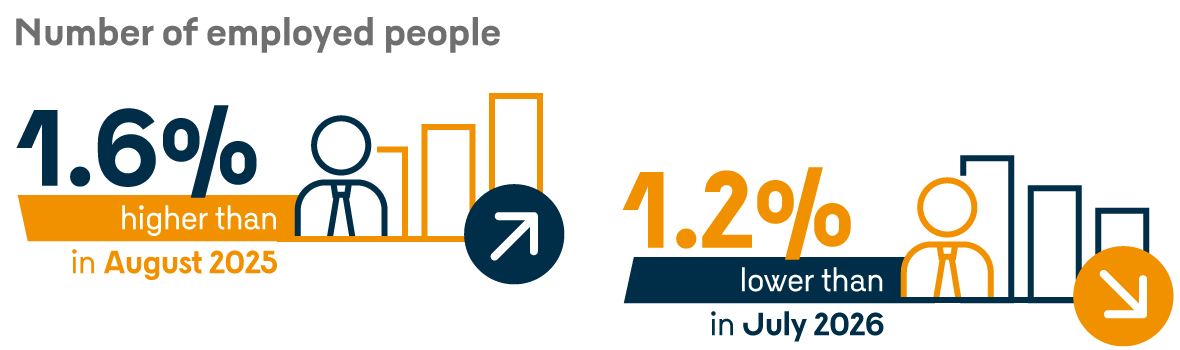
- In August 2026, the number of employed people was 1.6% higher than in August 2025 but fell by 1.2% compared with July 2026.
- This monthly decline was concentrated mainly in rural areas and was reflected in a lower employment rate across all geographic domains.
The August earthquake may have affected employment.

- The earthquake that occurred on August 10 may have affected employment in the hardest-hit cities.
- To analyze this possibility, the report compared the evolution of labor market indicators in the affected areas with those in other main cities.
Salaried employment continues to grow, while non-salaried employment is losing momentum.
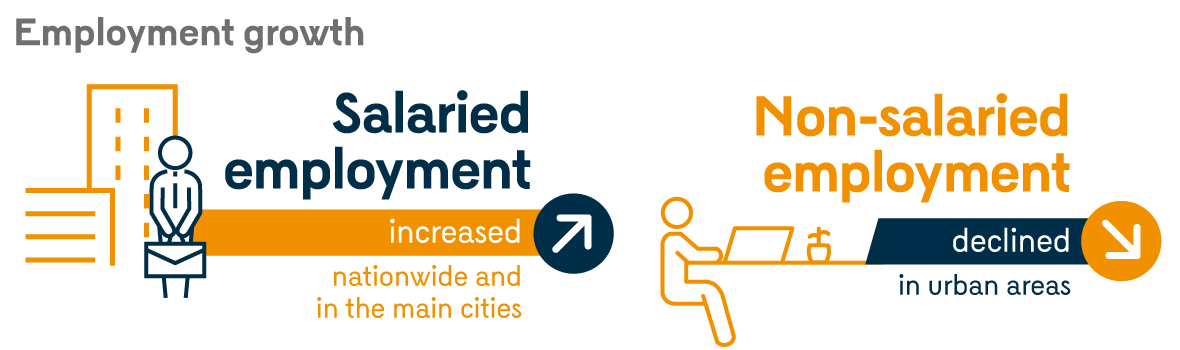
- The number of salaried workers increased both nationwide and in the twenty-three main cities and metropolitan areas.
- By contrast, non-salaried employment declined in urban areas.
- By economic sector, employment declined in agricultural and livestock, recreational and professional activities. In contrast, it increased for trade and accommodation, transportation and communications, and construction.
Formal employment is growing faster than informal employment.
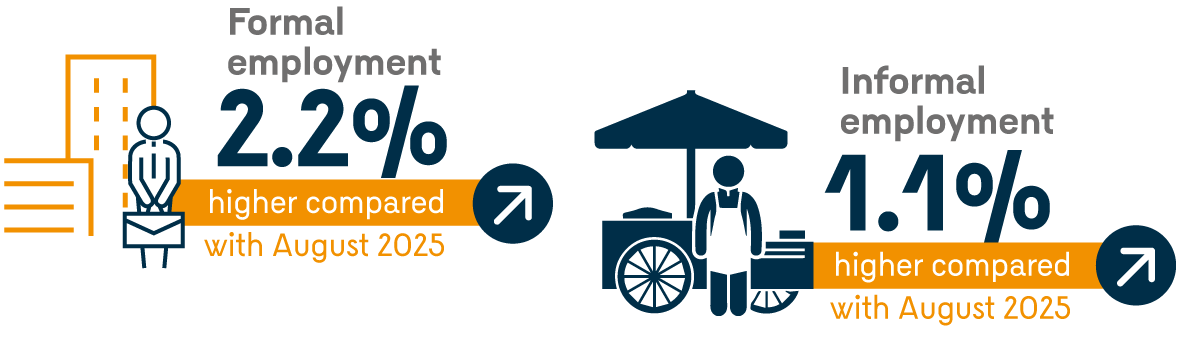
- In August, formal employment increased by 2.2% compared with the same month in 2025, while informal employment grew by 1.1%. As a result, the share of informal workers stood at 55.1%, slightly below the level recorded a year earlier.
- This suggests that, despite the recent slowdown in employment, formal employment continues to grow at a faster pace than informal employment.
- Employers are showing weaker demand for workers. This is suggested by various job vacancy indicators from the Public Employment Service (SPE in Spanish), classified ads, and job vacancies estimated using the Colombian Household Survey (GEIH, by its acronym in Spanish).
Unemployment increased vis-a-vis the previous month, but remains below the level recorded a year earlier.
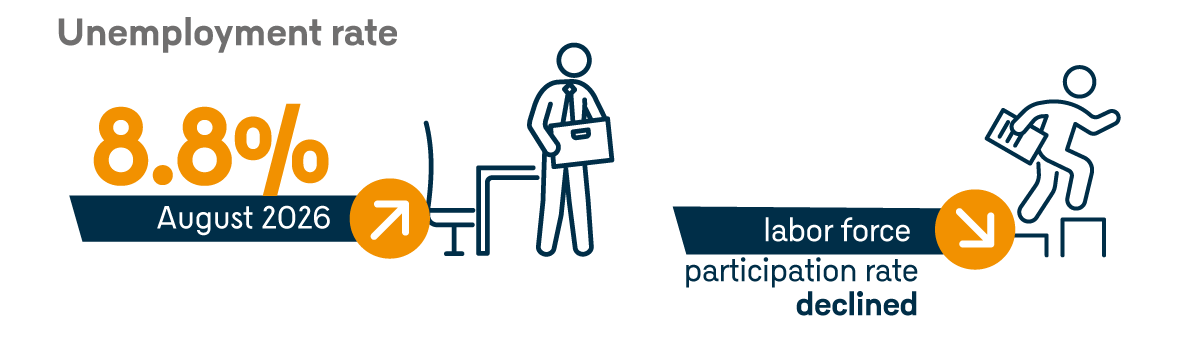
- In August, the national unemployment rate was 8.8%.
- The share of people who are employed or actively seeking work also declined. This lower labor force participation partially offset the decline in employment.
- Despite the increase in unemployment and the decline in job vacancies, some indicators continue to point to a relatively tight labor market (with some difficulties in filling vacancies).
Labor income continues to increase, especially among salaried workers.
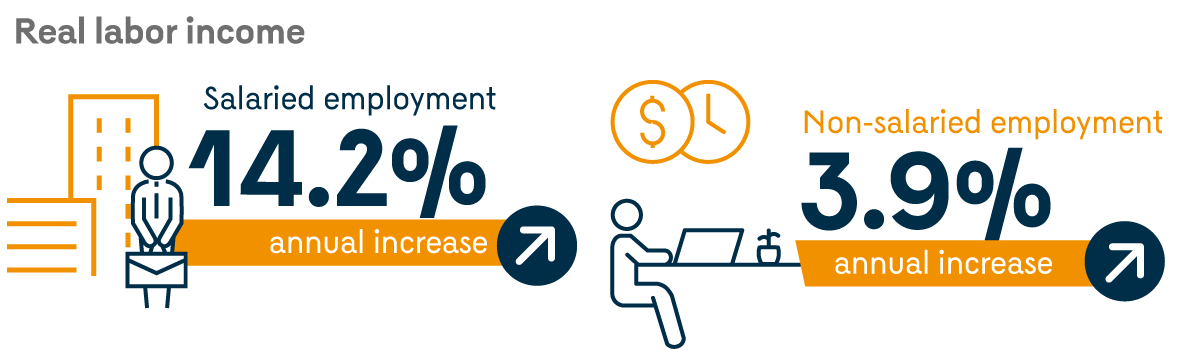
In August, real labor income (that is, labor income adjusted for the effect of inflation) increased by 14.2% annually among salaried workers and by 3.9% among non-salaried workers.
In its second section, the report assesses the effects of the unemployment protection mechanism implemented in Colombia since 2013.
The technical staff of Banco de la República (the Central Bank of Colombia) projects the average urban unemployment rate at 9.15% in 2026 and 9.58% in 2027. These projections take into account various risk scenarios, which are explained in detail in the October 2026 Monetary Policy Report.
1 ↑ Data are presented on a rolling quarterly basis and are seasonally adjusted. Source: National Administrative Department of Statistics (DANE in Spanish), Colombian Household Survey (GEIH); calculations by Banco de la República.