Labor Market Reports – Increase in Formal Employment Driven by the Non-Salaried Segment and Gender Gap Dynamics over the Past Four Decades
The Labor Market Report (RML in Spanish) series is a quarterly publication by the Labor Market Analysis Group (GAMLA, in Spanish) of Banco de la República (the Central Bank of Colombia), a group created in 2017. Opinions and possible errors are the author’s sole responsibility, and its contents do not compromise Banco de la República nor its Board of Directors.
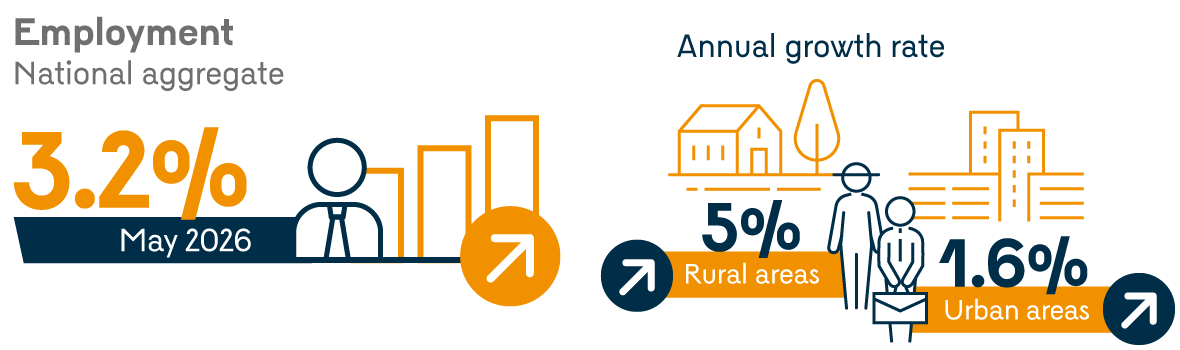
According to the Colombian Household Survey (GEIH, by its acronym in Spanish), as of May 2026, employment in the national aggregate continues to increase in annual terms, mainly explained by the performance of rural areas. By employment status, the employment increase is concentrated in the non-salaried segment..

According to the Colombian Household Survey (GEIH), as of May 2026, employment in the national aggregate continues to increase in annual terms by 3.2%, mainly explained by the performance of rural areas, which recorded a 5.0% annual growth rate, while employment in the twenty-three main cities increased by 1.6%.
- This was reflected in the heterogeneous performance of the employment-to-population ratio (EPR), which continued to increase nationwide by 1.1 annual percentage points (pp), in line with the dynamism observed in rural areas.
- Meanwhile, in urban areas, the EPR has remained relatively stable, with some moderate declines so far this year.
By employment status, employment performance is concentrated in the non-salaried segment, while salaried employment is increasing at a much more moderate pace.
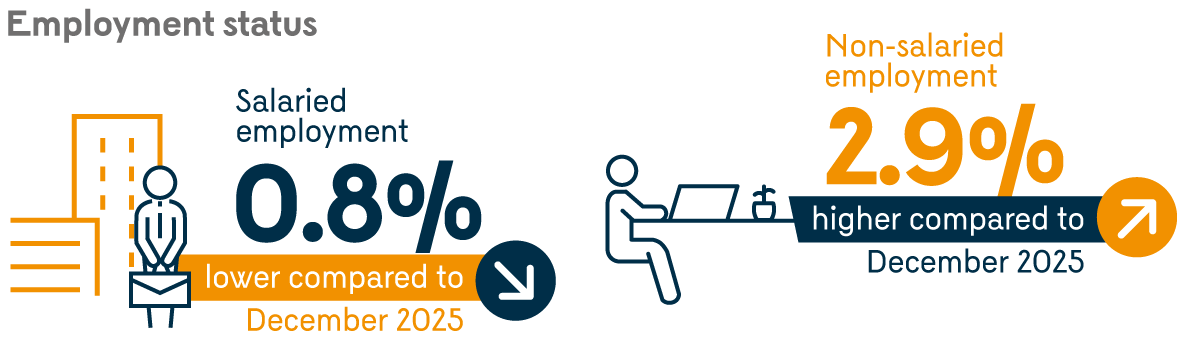
- This trend is more pronounced in the year-to-date figures: at the national level, salaried employment is 0.8% lower than its level observed in December 2025; in turn, non-salaried employment is 2.9% higher.
- This divergent employment pattern is much more pronounced in urban areas.
Formal employment, under the new definition adopted by the National Administrative Department of Statistics (DANE in Spanish), is increasing at a significant pace in the national aggregate. However, this is mainly explained by the stronger performance of non-salaried formal employment, which includes contractors and self-employed workers.

- In contrast, salaried employment with social security contributions has shown a loss of momentum, consistent with information from administrative records.
- The recent dynamics of non-salaried formal employment has contributed to the decline in the informality rate, which stood at 54.5% in May.
- Other indicators of labor demand, such as the vacancy indexes of the Public Employment Service (SPE in Spanish) and help-wanted ads indexes, show a recovery in April. However, hiring expectations continue to exhibit mixed signals.
On the labor supply side, labor force participation continued to increase in the national aggregate, mainly explained by the stronger dynamism of rural areas, while it declined in urban areas.
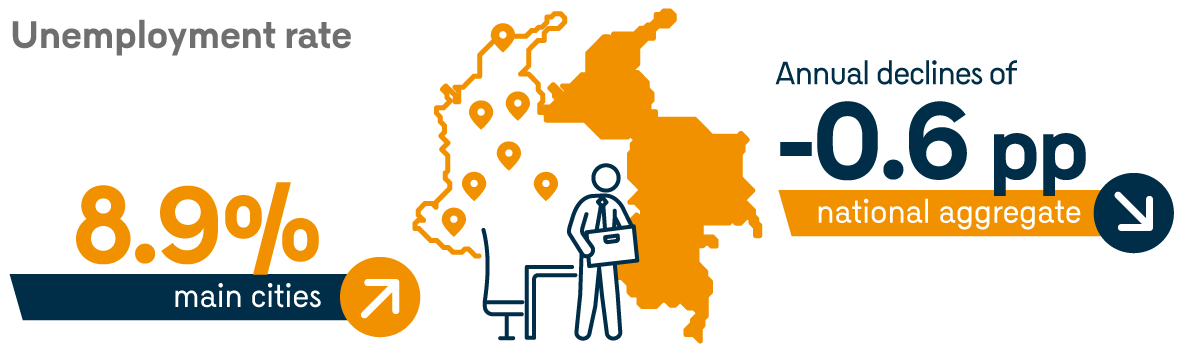
- Lower labor force participation rate in the twenty-three main cities has contributed to moderate increases in the unemployment rate (UR) in this geographic domain, bringing it to 8.9% as of May, slightly higher than that observed in December 2025.
- In contrast, the national UR continued to record annual declines of -0.6 pp, consistent with the dynamism of the UR in rural areas.
The combination of the vacancy rate and the UR shows that the labor market remains tight and continues to lie in the upper-left quadrant of the Beveridge curve.
- This configuration is consistent with relatively high labor demand compared with the number of unemployed persons and may be associated with wage pressures.
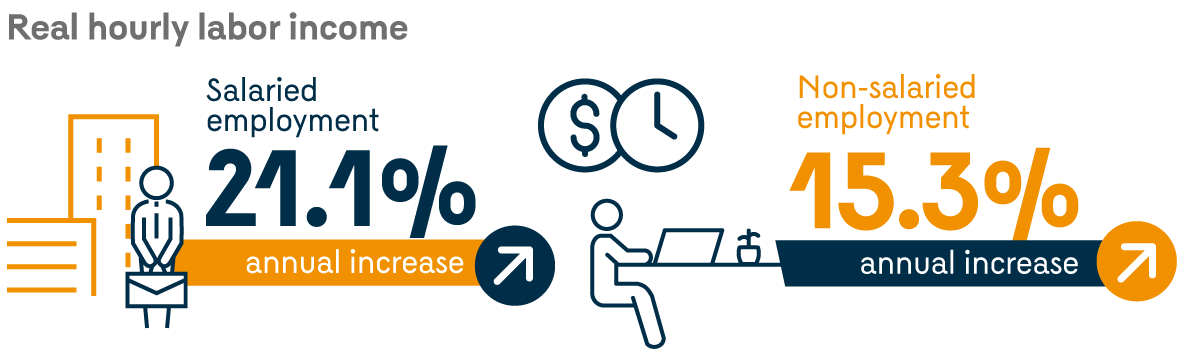
- Indeed, as of May, real hourly labor income recorded annual increases of 21.1% for salaried workers and 15.3% for non-salaried workers.
Based on these factors, the UR estimates prepared by the technical staff of Banco de la República (the Central Bank of Colombia), whose risk scenarios are explained in the July 2026 Monetary Policy Report, suggest that the average urban UR would be 8.8% in 2026 and 9.8% in 2027.