Financial Markets Report – Second Quarter of 2025
The main purpose of these documents is to provide quarterly information on financial markets. Opinions and possible errors are the sole responsibility of the author and their contents do not compromise the Board of Directors of Banco de la República (the Central Bank of Colombia, Banrep).
During the second quarter of 2025 (2Q25), global financial markets operated in a context of high uncertainty, driven by trade tensions, fiscal concerns, and geopolitical risks. However, economic activity showed signs of resilience, and markets recorded partial recovery. International financial conditions remained relatively favorable, despite episodes of volatility. In Colombia, inflation continued to decline, although it remained above the target set by Banco de la República (the Central Bank of Colombia, Banrep), which maintained a prudent monetary policy stance in response to a slower decline in inflation, increased external uncertainty, and domestic fiscal challenges.

The international environment remained characterized by high uncertainty, although with signs of economic resilience.
- Global financial markets began the second quarter of 2025 (2Q25) amid trade tensions driven by new policy announcements by the United States. However, progress in trade negotiations allowed for subsequent partial recovery.
- Fiscal uncertainty in the US intensified, especially amid the legislative debate over a new fiscal package approved on July 4.
- Geopolitical tensions in the Middle East increased, causing increased volatility in the markets.
- Despite these factors of uncertainty, global economy maintained the resilience it has shown in recent years.

Inflation remained above the targets set by central banks in most developed economies, leading them to adopt cautious policy stances. In Latin America, inflation and monetary policy conditions were heterogeneous.
- In the Euro Zone, inflation returned to the 2.0% target, while in other economies it remained above the target set by central banks.
- Central banks maintained a cautious stance, although some cut their interest rates due to specific domestic conditions.
- Interest rate expectations were revised upward following the anticipated cuts after the trade-related news in April.
- Inflation remained above target in most countries in the region. In Colombia, it continued to decline but remained above Banrep’s target.
- Monetary policy decisions in the region were mixed. Banrep cut its rate in April and kept it unchanged in June, amid a moderate reduction in inflation, increased external uncertainty, and domestic fiscal challenges.
- Although further cuts in Colombia’s monetary policy rate continue to be anticipated, these are expected to be more moderate than projected at the end of the previous quarter.

Debt markets reflected heterogeneous dynamics in both advanced and emerging economies.
- US Treasury bonds depreciated at the long end of the curve, reaching their highest yields since 2023. In contrast, other developed economies saw gains across their curves.
- In Latin America, most sovereign securities appreciated, while in Colombia, TES (bonds issued by the Colombian Government) continued to depreciate, reflecting persistent fiscal risk in a scenario of lower liquidity and higher volatility.
- At the end of June, Moody's and S&P downgraded Colombia's local currency credit rating, causing TES to lose their investment grade.
- Foreign investors were net buyers of TES in the spot market during the quarter. However, following the loss of investment grade, they made significant sales in June and early July.
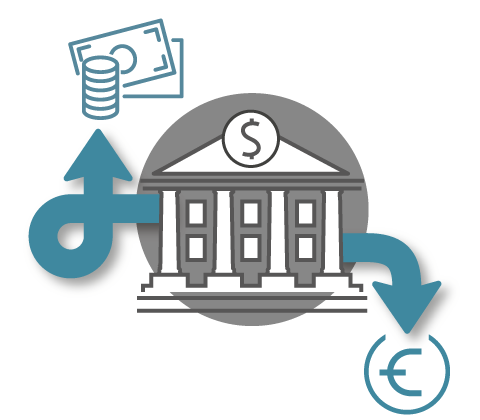
Regarding the foreign exchange market, the Colombian peso appreciated in a context of global dollar weakness.
- The US dollar weakened amid fiscal and trade uncertainty in the United States, as well as moderation in the country’s economic growth expectations.
- Latin American currencies appreciated, although with high volatility due to sensitivity to trade-related news.
- The Colombian peso (COP) appreciated, but to a lesser extent than its regional peers, due to local fiscal concerns.
Commodity prices showed a mixed performance, driven by geopolitical and trade-related factors, while stock markets continued to perform favorably.
- Oil prices declined due to increased production by the OPEC+ (Organization of Petroleum Exporting Countries and its allies) and expectations of lower global demand.
- Precious metals such as gold and silver reached all-time highs due to demand for safe-haven assets, while industrial metals and agricultural commodities fell, reflecting the manufacturing slowdown and trade tensions.
- Stock markets in developed countries rose following declines in April, with recovery supported by easing trade tensions and solid corporate results.
- In Latin America, stock indexes extended the positive momentum observed in the first quarter of the year. In Colombia, the MSCI Colcap also maintained its upward trend, although with a lower trading volume.

Index of Boxes in the Report
 Box 2: Progress in Colombia’s Integration into the Global Foreign Exchange Committee
 Reports
 Boxes
Boxes