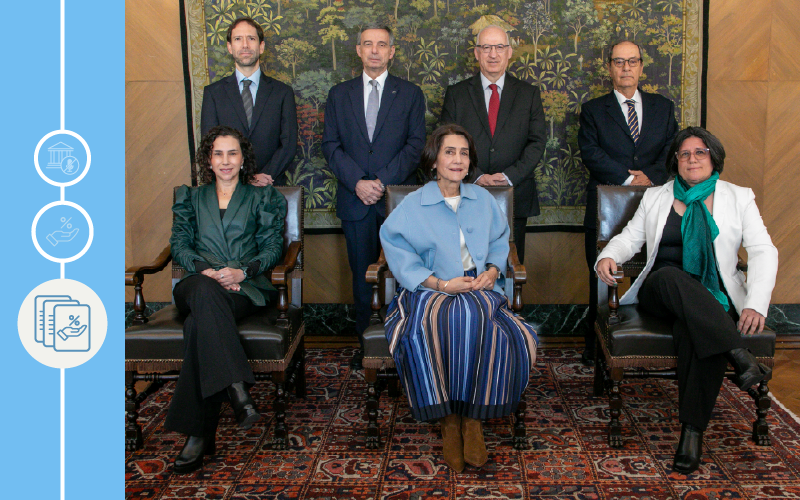
BanRep Minutes: The Board of Directors of Banco de la República decided by majority vote to increase the benchmark rate by 75 basis points (bps) to 12%
- Headline inflation in May stood at 5.8% and core inflation (excluding food and regulated items) at 6.0%, moving further away from the 3.0% target, in line with the technical staff’s forecasts. The main upward pressures came from the services component, driven by increases in rents and other indexed services. Likewise, inflation for regulated goods and services increased due to higher gasoline and utility prices.
- Inflation expectations have exhibited volatile behavior throughout the first half of the year. Through May, both inflation expectations derived from surveys and those implied by the public debt market increased across all horizons. However, the latter partially reversed during June. Despite this, the different measures of inflation expectations remain significantly above 3.0% across all horizons, standing at around 6.5% for the end of this year.
- DANE reported that, in its seasonally adjusted series, annual GDP growth in the first quarter of 2026 was 2.2%, exceeding the expansion observed in the fourth quarter of 2025 (2.0%). Domestic demand has continued to grow at a stronger pace than output, with notable increases in public consumption, private consumption of durable goods, and investment in machinery and equipment.
- The labor market continues to record historically low unemployment rates; according to seasonally adjusted figures, these stood at 8.1% nationwide and 8.5% in the metropolitan area in May. Wage increases were also observed, suggesting a tight labor market.
- Uncertainty regarding the external environment remains high due to the persistence of the conflict in the Middle East and its effect on international fuel prices, transportation costs, and fertilizer prices. In addition, uncertainty remains regarding the reaction of financial markets to monetary policy decisions in advanced economies.
The majority of Board members who voted to increase the policy interest rate by 75 basis points emphasized that over the past 12 months, inflation has kept an upward trend, rising 100 basis points from a low of 4.8% in June 2025 to 5.8% in May 2026. They noted that a large share of that increase (71 basis points) has occurred since last December, when inflation stood at 5.1%. They added that this pattern has spread across many components of the consumer basket, making it difficult to explain by factors other than excess demand and the sharp 2026 increase in the minimum wage. They highlighted that this has led to inflation expectations becoming unanchored, not only for the end of 2026 but also over longer horizons, reflecting a serious deterioration in the credibility of the inflation target and of the inflation-targeting framework on which monetary policy is based. They noted that this trend has occurred in a context where domestic demand growth has exceeded output growth, associated with high fiscal deficits that continue to support domestic demand despite the relatively restrictive monetary policy stance maintained by Banco de la República . They warned that the technical staff’s forecasts indicate inflation will continue to rise to levels above previously expected, in particular for the remainder of 2026, even without taking the El Niño phenomenon into account. They indicated that the high probability of this event, together with the difficulty of predicting its intensity and duration, introduces a high degree of uncertainty regarding the future path of inflation. On the other hand, they noted that the country risk premium has declined significantly in recent months. This lower perceived risk has been reflected in an appreciation of local assets and in a strengthening of the peso that has exceeded that observed in several comparable currencies. They noted that this has partially mitigated some inflationary pressures by reducing the cost of imported goods. However, they warned that, in a context of still-dynamic domestic demand, this appreciation has also encouraged an increase in imports, which have grown at rates above 10% year-to-date through April, contributing to the deterioration of the country’s trade balance. Regarding economic activity, they stated that it has shown slightly stronger dynamism than expected, accompanied by positive signals from the labor market. They explained that this reduces monetary policy trade-offs by lowering the sacrifice ratio. They argued that this creates favorable conditions for a significant increase in the policy interest rate that would place monetary policy in a better position to address the current balance of risks. From a macroeconomic perspective, this group of Board members reiterated the need to initiate a structural adjustment of public finances that would not only support monetary policy in its effort to steer inflation toward its target but also help restore the space that fiscal imbalances have taken away from investment in the country, which they viewed as the only path toward achieving stronger and sustainable economic growth.
Board members who voted for a 50-basis-point reduction in the policy interest rate considered further increases in the policy rate inappropriate given the current monetary policy stance and the latest macroeconomic developments. They argued that annual inflation has eased from the peaks reached in previous years and that it has been driven more by supply shocks and indexation to past inflation than by demand factors that would justify a more contractionary monetary policy stance. In particular, they noted that annual food inflation has reflected weather-related factors affecting agricultural production and food supply, as well as international geopolitical tensions that have increased global supply chain and agricultural input costs. They added that increases in services inflation have been driven by indexation and higher rents. They observed that analysts’ inflation expectations for the end of 2026 have assigned significant weight to food inflation, which is affected by supply-side factors. Evidence of this can be seen in the fact that core inflation expectations in May declined relative to their January levels, unlike headline inflation expectations. They noted that the external geopolitical environment is also generating supply-side pressures by increasing oil prices and international transportation costs. They reiterated that these factors cannot be controlled by increases in the policy interest rate and instead affect the domestic economy's growth dynamics. They pointed out that the U.S. Federal Reserve maintained its policy interest rate unchanged at its most recent meeting and that expectations point to stability during the remainder of the year. In this environment, they warned that additional increases in interest rates in Colombia would further widen interest-rate differentials, attracting speculative capital inflows that could intensify the peso's appreciation, potentially weakening the export sector and the domestic consumer-goods manufacturing sector, which is already being affected by Chinese imports. They added that higher interest rates also encourage carry trade activity, for which there are already signs, increasing the economy’s vulnerability to a subsequent reversal of capital flows. Finally, they emphasized that GDP growth of 2.2% in the first quarter—only slightly above that observed in the fourth quarter of 2025 (2.0%)—shows some signs of weakening economic activity. In their view, this suggests that further increases in the policy interest rate would not be appropriate, as they could discourage investment and affect this already weak momentum at a critical time for the Colombian economy.
The Board member who voted to keep the policy interest rate unchanged argued that inflation is increasing but at a slower pace and that overall, although some demand-side factors are present, it continues to be explained primarily by supply-side factors. They noted that, in essence, inflation results from a combined shock involving inflationary inertia and external factors. They indicated that the increase in the Producer Price Index (PPI) is largely explained by the mining and energy component, reflecting the global increase in extractive commodity prices. They further noted that a large share of the upward pressure stems from rents, owing to both inflationary inertia and other factors affecting this component. Regarding the real sector, he pointed out that employment remains stable and growth remains weak, while some signs of recovery are evident in industry. At the same time, the agricultural sector has weakened due to weather-related factors. Finally, they noted that although the appreciation of the domestic currency has helped reduce borrowing costs, the yield differential associated with high interest rates may keep the exchange rate appreciated and, through its effects on production, weaken national competitiveness, alongside a deterioration in domestic demand and persistently high interest rates that do not encourage productive investment. They emphasized that an important message concerns the ongoing reallocation of employment, which is not yet fully understood, and the need to continue laying the foundations for an economic transformation based on greater economic complexity and higher-quality employment while maintaining low unemployment rates.
The decision adopted by the majority of Board members remains aimed at ensuring that inflation returns to a downward path. Future decisions will depend on new information as it becomes available.