Servicios
|
See additional information in "Banco de la República transforms its Communication Scheme for Monetary Policy Decisions"
|
|
See additional information in "The Board of Directors of Banco de la República notifies updates to some of its calendar of monthly meetings and monetary policy announcements"
|
|
See additional information in "The Board of Directors of Banco de la República notifies updates to some of its calendar of monthly meetings and monetary policy announcements"
|
|
See additional information in "The Board of Directors of Banco de la República notifies updates to some of its calendar of monthly meetings and monetary policy announcements"
|
|
After being stagnant for the first half of the year, employment grew again in July and August. This upturn in employment has been particularly marked in the intermediate municipalities and rural areas. Going by segments of national employment, non-wage employment—which had slowed down in the second…
|
|
The opinions contained in this document are the sole responsibility of the author and do not commit Banco de la República or its Board of Directors.
|
|
Employment continued to recover in the second half of 2020, after dropping sharply during the first six months of the year. However, the labor market, in general, is still extremely slack as a result of the Covid-19 health crisis, and there are major disparities between population groups and…
|
|
Based on the counting of Help-wanted advertisements in print newspapers, we present national vacancy indexes and vacancy rates for Colombia. These series will allow tackling a myriad of questions related to the functioning of the labor markets in emerging economies, where such datasets were not…
|
|
Historically, when an economy emerges from recession, employment grows with, or soon after, the resumption of GDP growth. However, following the two most recent recessions in the United States, employment growth has lagged the recovery in GDP by several quarters, a phenomenon thathas been termed…
|
|
José Antonio Ocampo, co-director of Banco de la República, was appointed as one of the seven senior advisors of The Global Deal, an initiative of the Swedish Government and the International Labour Organization (ILO) that promotes social dialogue to achieve quality jobs and advances in global…
|
|
The Editorial Board of The Banker, a British magazine belonging to the The Financial Times Group, named José Dario Uribe as the American continent’s “Central Banker of the Year”. An annual event, this designation was made public in the January issue of The Banker, which began circulating…
|
|
“… the costs of informality are higher: workers have limited social protection, businesses are less productive, and the state has reduced capacity to collect taxes and provide public goods. This leads to inefficient allocation of resources, which negatively impacts the country's economic growth.”
|
|
The extern
|
|
"Although these frictions affect various credit markets, they are especially relevant in rural areas of developing countries due to transportation difficulties and lack of formal documentation.”
|
|
How will population aging and declining fertility shape the future of Colombia and its regions? This article examines the evolution and outlook of demographic change, compares alternative scenarios, and shows how regional differences may influence economic growth, health care, education, and…
|
|
Without an equitable redistribution of unpaid care work, it will not be possible to close gender gaps in Colombia.
|
|
Looking ahead, monitoring financial stability, macroeconomic (dis)equilibria, and the space for active economic policy—with inflation close to the target and sustainable public finances—are necessary conditions to successfully face future adverse shocks.
|
|
We set a dynamic stochastic model for the interbank daily market for funds in Colombia. The framework features exogenous reserve requirements and requirement period, competitive trading among heterogeneous commercial banks, daily open market operations held by the Central Bank (auctions and window…
|
|
Since: 2014
|
|
EducationPh.D. in Economics, University of Chicago, Chicago IL, 2010 - 2017Specialization fields: Finance- Asset Pricing, Applied Macroeconomics, University of Chicago, Chicago IL, 2010 - 2017M.A. in Economics, University of Chicago, Chicago IL, 2011 – 2014Master’s in Business Administration-MBA,…
|
|
Juan Sebastián is Chief Officer for Risk Management since April 2023 and is responsible for managing the Bank’s cross-cutting financial and non-financial risks. He joined the institution in 2002 and has since served as Head and Director of Markets Development at the Operations and Financial Markets…
|
|
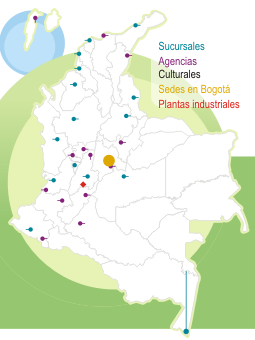
Juliana Restrepo Tirado is Chief Officer for Cultural Affairs of Banco de la República (the Central Bank of Colombia) since May 25, 2026. Her scope of work includes 29 cultural centers in the country with libraries and museums.
|