Labor Market Reports – Moderation in Employment Dynamics and the Effects of Demographic Change on the Long-Term Unemployment Rate
The Labor Market Report (RML in Spanish) series is a quarterly publication by the Labor Market Analysis Group (GAMLA, in Spanish) of Banco de la República (the Central Bank of Colombia), a group created in 2017. Opinions and possible errors are the author’s sole responsibility, and its contents do not compromise Banco de la República nor its Board of Directors.
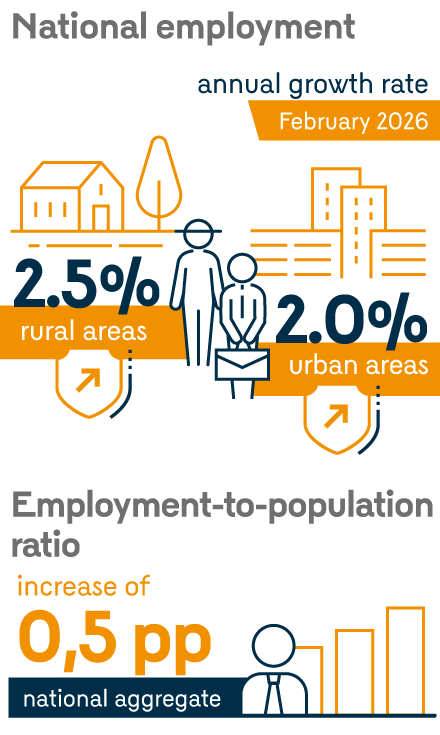
According to the Colombian Household Survey (GEIH, by its acronym in Spanish), as of February 2026, employment continues to increase in annual terms, mainly driven by rural areas, which exhibited a 2.5% growth rate, while the twenty-three main cities showed an annual growth rate of 2.0%. On the other hand, estimates by the technical staff of Banco de la República (the Central Bank of Colombia) suggest that the average urban unemployment rate would lie at 8.9% in 2026 and 9.8% in 2027.

According to the Colombian Household Survey (GEIH), as of February 2026, employment continues to increase in annual terms, mainly driven by rural areas, which exhibited a 2.5% growth rate, while the twenty-three main cities showed an annual growth rate of 2.0%.
- However, lower dynamism is observed at the margin, particularly in urban areas, where quarterly variation stood at 0.2%.
- This performance explains the recent moderation in employment rates, whose annual increases were 0.5 percentage points (pp) in the national aggregate and 0.4 pp in urban areas.
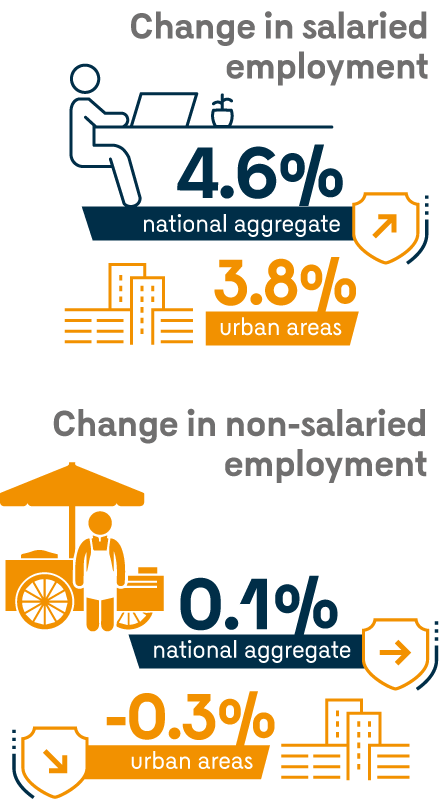
By type of employment, annual changes in salaried employment remain positive at 4.6% and 3.8% in the national aggregate and the urban areas, respectively. In contrast, non-salaried employment shows moderate annual increases, or even negative ones (0.1% national and -0.3% in urban areas).
- This weaker performance of non-salaried employment is largely explained by the slowdown in agricultural employment, particularly in activities such as coffee growing.
- At the margin, however, these trends may be changing, given a smaller increase in salaried employment during the last quarter, particularly in urban areas. This recent weaker dynamism in salaried employment is concentrated in economic sectors with greater minimum wage coverage.
- Other sources of information on salaried and formal employment, such as administrative records, also show positive annual change. This has contributed to a moderate reduction in the informality rate, which stood at 54.8% in the national aggregate in February.
- Similarly, other sources of labor demand indicators, such as vacancy indexes from the Public Employment Service (SPE in Spanish), exhibited a moderate decline as of February, while help-wanted ads and the GEIH remained stable. Consistent with the above, hiring expectations also show mixed signals.
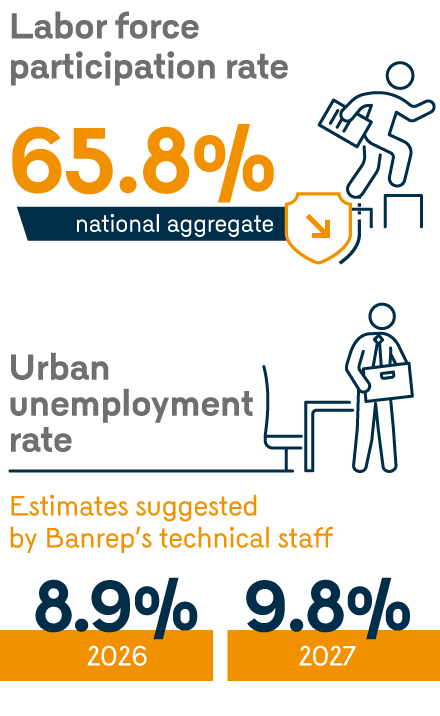
On the labor supply side, a moderate decline is observed in the labor force participation rate both in the national aggregate and in urban areas, lying at 65.8% and 64.5%, respectively.
- This decline in labor force participation mainly explains the moderate decrease in the unemployment rate (UR) as of February, which remains at historically low levels.
- In turn, the combination of a low unemployment rate and a stable labor demand reflects a tight labor market, located in the upper-left quadrant of the Beveridge curve.
- This is consistent with the annual real increase in hourly wages, which as of February showed increments of 16.7% and 14.7% in the salaried and non-salaried segments, respectively.
- Based on these factors, UR estimates prepared by Banco de la República's technical staff, whose risk scenarios are explained in the April 2026 Monetary Policy Report, suggest that the average urban UR would stand at 8.9% in 2026 and 9.8% in 2027.
Complete issues of the Labor Markets Report
2026

2025